Cherry Blossom Season By Bike In Kyoto: Where And When To Ride
Kyoto's cherry blossom season is short, datable and rideable: the observatory puts normal full bloom at 4 April, and guided e-bike rides cover the Silver Pavilion, Higashiyama and Arashiyama sides of the city.
Short answer
Kyoto's cherry blossom normally flowers 26 March and reaches full bloom 4 April; in 2026 it flowered 23 March and peaked 30 March. Guided spring options include the Silver Pavilion and Philosopher's Path e-bike ride from ¥14,500 per person and the Early Bird Bamboo Forest ride from ¥16,000 per person.
Spring is the one Kyoto season where the calendar does half the planning for you. The city's own blossom record gives fixed reference dates, and the Silver Pavilion and Philosopher's Path e-bike ride is one of several guided options that fan out across the districts where the trees actually are, so a sakura visit pairs naturally with a booked ride rather than a self-planned route. Kyoto Bike Tours covers the whole year, but this guide is for the narrow window when blossom decides where you point the front wheel.
| Fact | Detail |
|---|---|
| Normal flowering date (1991-2020) | 26 March, Kyoto observatory |
| Normal full bloom (1991-2020) | 4 April, Kyoto observatory |
| 2026 season | Flowering 23 March, full bloom 30 March |
| Record flowering range | 16 March 2021 to 9 April 1984 |
| March rainfall | 106.2 mm monthly normal |
| April rainfall | 117.0 mm monthly normal |
| April mean daily maximum | 20.1 °C |
| Ginkaku-ji admission | 1,000 yen adult, 500 yen child, since 1 April 2026 |
When Does Cherry Blossom Season Happen In Kyoto?
The Kyoto observatory's 1991-2020 normals put flowering at 26 March and full bloom at 4 April, but the spread is wide: flowering has landed anywhere from 16 March (2021) to 9 April (1984), and full bloom from 24 March (2023) to 17 April (1965). In 2026 the season ran early, flowering 23 March with full bloom 30 March; in 2025 it ran close to normal, 27 March and 5 April.
Those figures come from the Japan Meteorological Agency's Kyoto observations, which track a designated reference tree rather than every tree in the city. That matters for planning: individual parks and riverbanks can run days ahead of or behind the observatory marker, and a warm week in March moves everything. The planning posture is a window, not a date: the last ten days of March through the first ten days of April cover the normal season, and the record range says book with flexibility either side.
The two recent seasons show how much a single year can drift from the normal, and in opposite directions:
| Season | Flowering | Full Bloom | Versus the 1991-2020 normal |
|---|---|---|---|
| Normal (1991-2020) | 26 March | 4 April | Reference point |
| 2025 | 27 March | 5 April | About one day late |
| 2026 | 23 March | 30 March | Several days early |
No operator can promise blossom on your booking date, and none of the rides described here is advertised as a sakura-specific product. What the rides do give you is free cancellation up to 24 hours before start on every ride mentioned in this guide, which is the practical tool for a season that shifts: book the date you want, watch the observatory announcements, and move the booking if the bloom runs early or late.
March and April are also not dry months. The agency's Kyoto monthly normals record 106.2 mm of rain in March and 117.0 mm in April, with an April mean daily maximum of 20.1 °C. Comfortable riding temperatures, real rain risk, and the strongest reason to keep a cancellable ride rather than a fixed one.
Which Areas Of Kyoto Work Best For Blossom Riding?
The blossom districts match the ride districts: the Silver Pavilion and Philosopher's Path corridor in the north-east, the Higashiyama temple slopes in the east around Kiyomizu-dera and Ginkaku-ji, and Arashiyama on the western edge, where the bamboo grove sits beside the Togetsukyo Bridge. Each of these areas has a guided ride on the roster, so the area decision and the ride decision are the same decision.
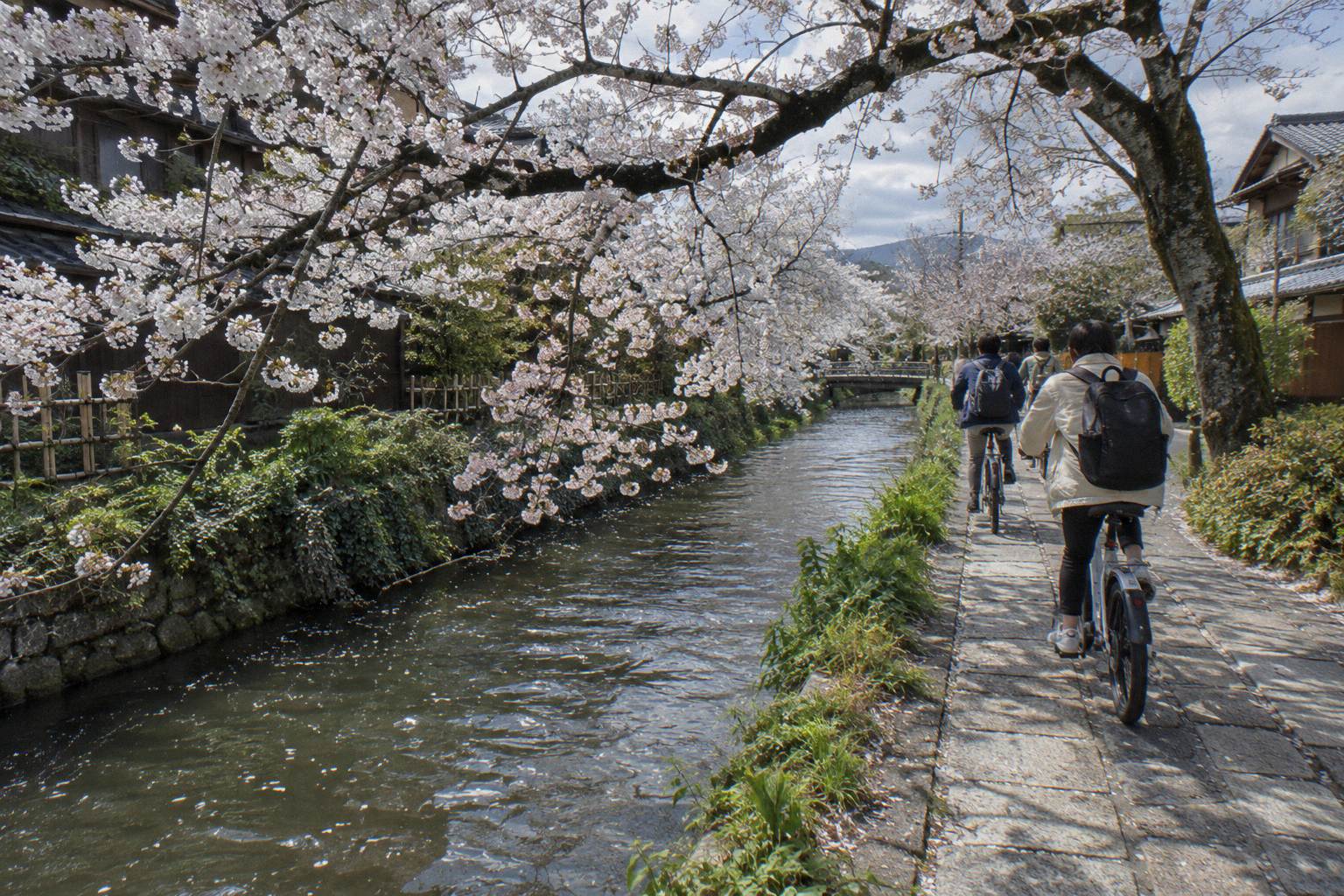
The Silver Pavilion end of the Philosopher's Path is the classic blossom corridor: a canal-side walk and ride area running south from Ginkaku-ji. A ride that finishes there, such as the Silver Pavilion and Philosopher's Path e-bike ride, from ¥14,500 per person for four hours with e-bike rental and guide included, rated 5.0 from 322 reviews, minimum age 12, puts you in the district rather than commuting to it. If the question is whether that ride earns its price in spring, the guided ride prices compared guide sets it against the rest of the roster.
Higashiyama, the slope east of the city centre, holds Kiyomizu-dera and runs north toward Ginkaku-ji. The "Explore Heritage and Landmarks of Kyoto with E-Bike Ride" (Higashiyama Heritage Ride) covers that ground: from ¥13,500 per person, four hours, minimum age 12, with entrance fees for Kiyomizu-dera and Ginkaku-ji included in the price. The route geometry questions are covered in the Higashiyama cycling route guide.
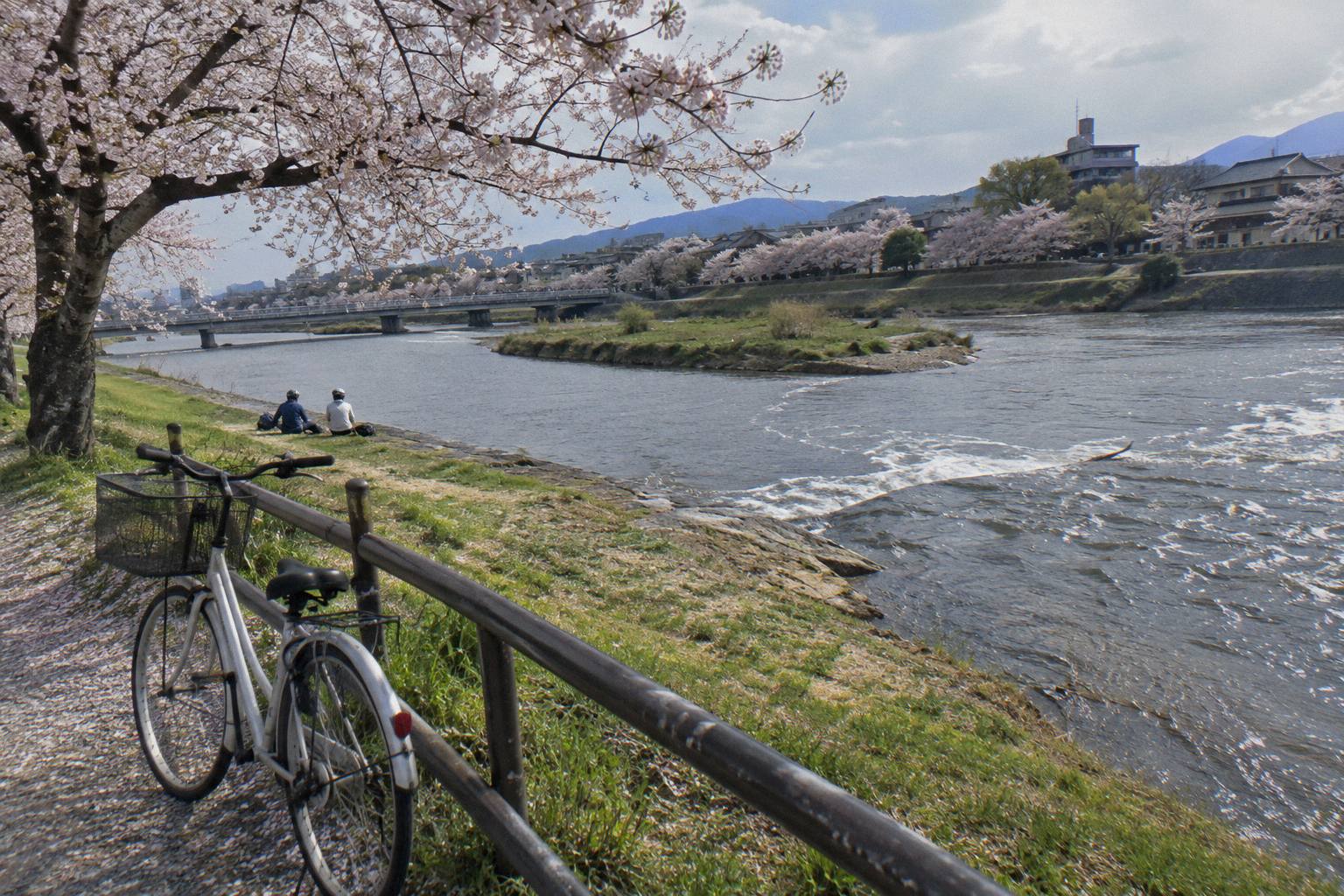
Arashiyama is further west, anchored by the Togetsukyo Bridge, a wooden bridge over the Katsura River that has been a landmark of the district for over four hundred years according to the Kyoto Tourism page on Togetsukyo Bridge. The Arashiyama by bike route guide covers the district in detail.
Three rides, three districts, all dated and cancellable:
Which Guided Rides Suit A Spring Visit?
Spring riders tend to want half-day, morning or early-start rides, because the season is compact and most visitors are stacking temples, food and blossom into the same 48 hours. The roster's spring-friendly picks are four-hour and early-start rides: the Silver Pavilion ride at 4 hours, the Higashiyama Heritage Ride at 4 hours, and the Early Bird Bamboo Forest ride at 3 to 4 hours.
The early-start case is about daylight use, not crowd promises. The "Kyoto Bamboo Forest & Hidden Gems: Early Bird Easy Bike Tour" (Early Bird Bamboo Forest Ride) runs 3 to 4 hours from ¥16,000 per person, rated 5.0 from 773 reviews, minimum age 10, with a native English-speaking bilingual guide, bottled water, a Cannondale multi-speed bicycle and a helmet included. An e-bike upgrade is excluded from the base price and needs an advance request, subject to availability. It is one of the few roster rides with "easy" in its own name, so the label is the product's, not a generalisation.
The Higashiyama Heritage Ride from ¥13,500 per person includes both temple entrance fees, which in spring matters: you are paying once and riding between two of the season's headline stops. It has fewer than 15 reviews, so there is no rating to quote; the price and inclusions are the decision data. The morning comparison across the roster is laid out in best time of day for riding.
If your spring days are fully committed, a full-day ride consolidates everything into one booking. "Bike Kyoto's Grand Loop: Full-Day Kyoto E-Bike Tour - 5 Top Sites" (Full-Day E-Bike, Lunch Included) runs 7 to 8 hours from ¥26,000 per person, rated 5.0 from 596 reviews, minimum age 16, with e-bike, light lunch, snacks, helmet and admission fees all included.
The half-day spring options side by side:
| Ride | Duration | Minimum age | Rating |
|---|---|---|---|
| Silver Pavilion, Philosopher's Path | 4 hours | 12 | 5.0 from 322 reviews |
| Higashiyama Heritage Ride | 4 hours | 12 | Fewer than 15 reviews, no rating quoted |
| Early Bird Bamboo Forest Ride | 3 hours to 4 hours | 10 | 5.0 from 773 reviews |
Between the half-day and full-day formats, the trade is simple: half-day rides leave the afternoon free for blossom walking; the full-day loop removes the need to plan a second activity. Either way, check the live price for your date before committing, because spring dates price differently from the off-season and the booking calendar shows the actual figure.
What Does Spring Weather Mean For Riding?
April is one of Kyoto's most comfortable riding months on paper: a mean daily maximum of 20.1 °C, and monthly rainfall of 117.0 mm that falls across scattered days rather than a single wet season. March is slightly cooler and slightly drier at 106.2 mm. Neither month carries the summer heat, and neither is inside the rainy season, which runs early June to mid July.
The temperature range is the point. August's mean daily maximum of 33.7 °C and the record of 39.8 °C are what summer riders face; April's 20.1 °C is long-sleeve riding weather, warm enough by midday, cool in the morning shade. A 3 or 4 hour ride fits comfortably inside the mild part of the day. Clothing specifics are handled in what to wear cycling in Kyoto.
Rain is the variable that needs a plan. Every ride in this guide carries free cancellation up to 24 hours before start, so a wet forecast two days out costs nothing to act on. What an operator does on the day when rain starts mid-ride is a policy question to ask the operator directly rather than assume. The general framework is in the guide to rides in wet weather.
How the blossom months sit against the extremes of the Kyoto year:
| Month | Rainfall | Mean temperature | Mean daily maximum |
|---|---|---|---|
| March | 106.2 mm | 8.8 °C | 14.1 °C |
| April | 117.0 mm | 14.4 °C | 20.1 °C |
| July (wettest) | 223.6 mm | 27.3 °C | 32.0 °C |
| August (hottest) | 153.8 mm | 28.5 °C | 33.7 °C |
What Do Temple Stops Cost And When Are They Open?
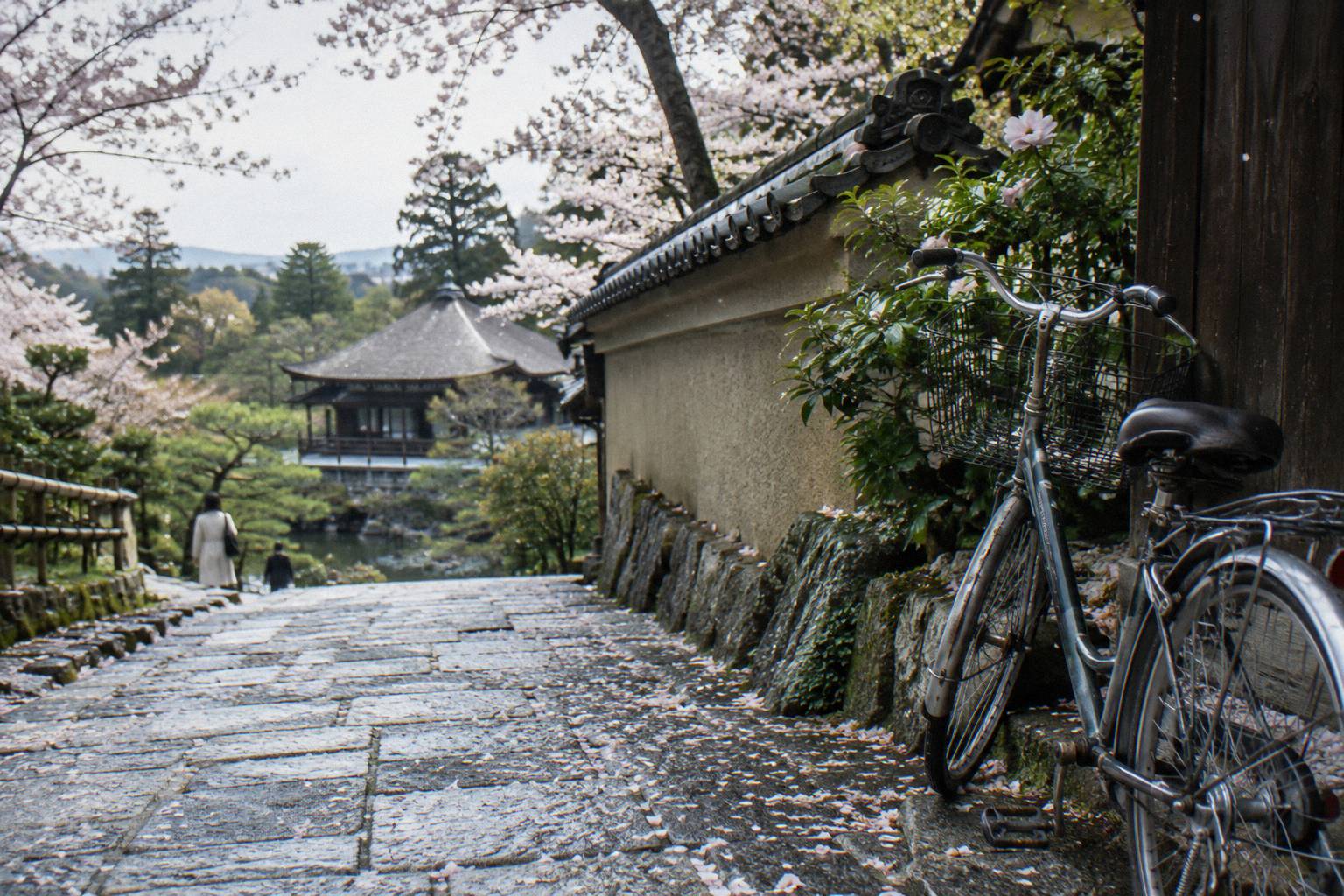
Ginkaku-ji, the temple at the north end of the Philosopher's Path, charges 1,000 yen for adults and 500 yen for children since 1 April 2026, when the adult fee doubled from 500 yen. Hours run 8:30 to 17:00 from 1 March to 30 November and 9:00 to 16:30 from 1 December to end of February. Fushimi Inari Taisha charges no admission fee at all, with around 10,000 torii gateways along its mountain paths.
The Ginkaku-ji fee change matters for spring budgeting because the temple sits on two of the rides discussed here by name: the Silver Pavilion ride and the Higashiyama Heritage Ride, whose price includes entrance to Kiyomizu-dera and Ginkaku-ji. On the Silver Pavilion ride, check whether the 1,000 yen fee is inside your booking or paid at the gate; the operator's inclusions list names e-bike rental, landing and facility fees, and a guide, with lunch excluded. The details are on Ginkaku-ji's official page.
For riders combining a booked ride with independent temple visits, the fee picture across the season's common stops:
| Stop | Admission | Hours | Note |
|---|---|---|---|
| Ginkaku-ji | 1,000 yen adult, 500 yen child | 8:30 to 17:00 (1 Mar to 30 Nov); 9:00 to 16:30 (1 Dec to end Feb) | Adult fee doubled on 1 April 2026 |
| Kinkaku-ji | 500 yen general, 300 yen primary and middle school | 9:00 to 17:00, open all year | Hours may change for exhibitions |
| Tenryu-ji (garden) | 500 yen high school and older | 8:30 to 17:00, last admission 16:50 | Buildings add 300 yen |
| Fushimi Inari Taisha | No admission fee | No closing time stated by the shrine | Around 10,000 torii gateways |
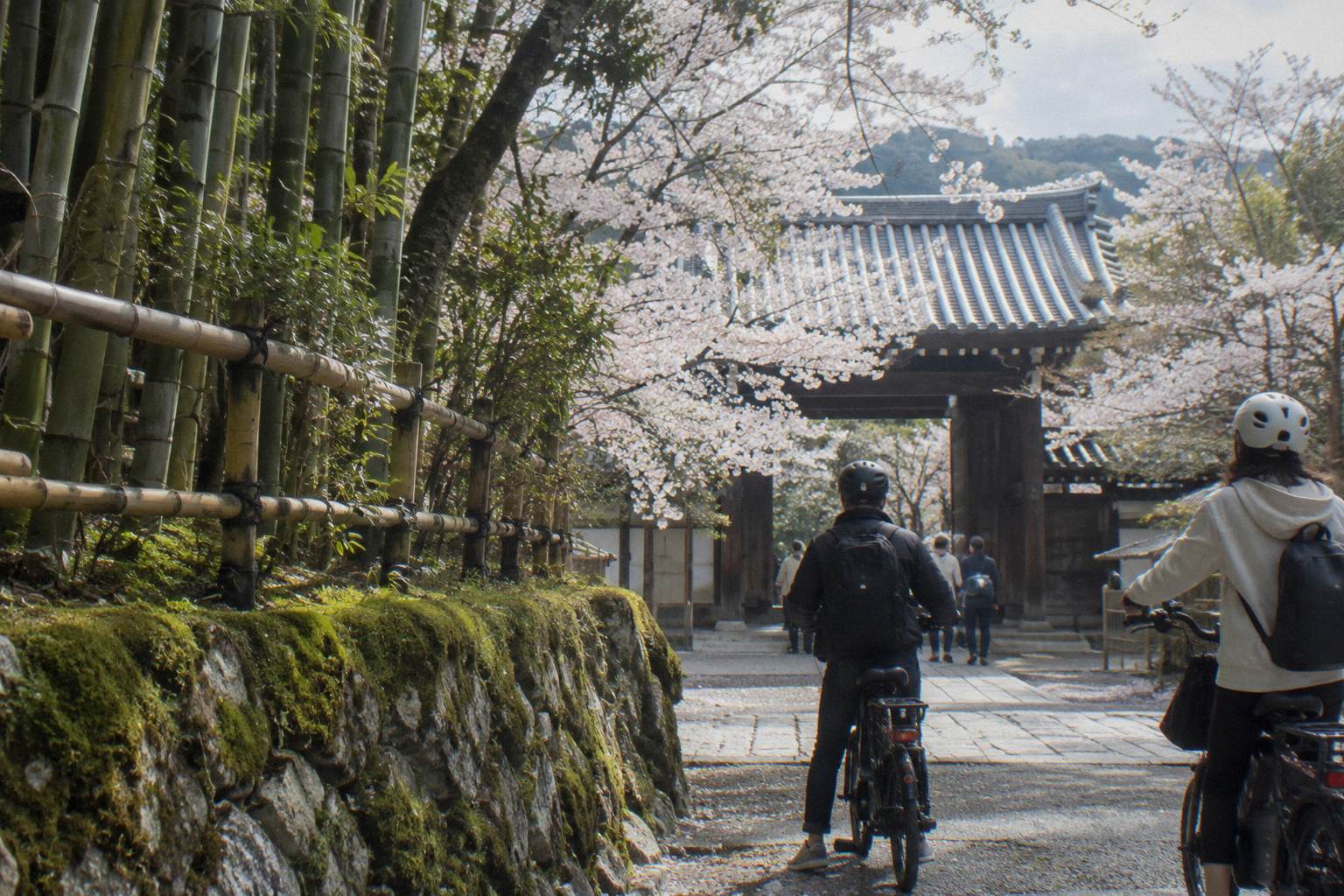
Arashiyama visitors riding the Early Bird Bamboo Forest Ride pass the district's two anchors: the bamboo grove itself, a public path that is free to walk, and Tenryu-ji beside it, whose hours and fees are on Tenryu-ji's visitor page. The grove is not a ticketed site, so a ride through the district carries no entry cost beyond the ride price itself.
What Rules Apply To Riders In Spring?
Spring visitors ride under the same rule set as everyone else, and two recent changes matter: since 1 April 2026 riders aged 16 and over who commit minor violations pay fixed fines of 3,000 to 12,000 yen instead of facing criminal procedure, and since 1 April 2023 every cyclist of every age has an effort duty to wear a helmet, with no fine attached. Kyoto Prefecture also requires bicycle liability insurance.
The fixed-fine list is specific, and the spring-relevant items are worth knowing by number. Holding or watching a phone while riding is 12,000 yen, the highest fixed fine, and since 1 November 2024 it can also bring up to 6 months in prison or a 100,000 yen fine. Ignoring a signal or riding on the wrong side costs 6,000, failing to stop at a stop sign 5,000, riding with an umbrella 5,000, and carrying a second rider or riding two abreast 3,000, all set out on the Kyoto City page on cycling rules.
| Violation | Fixed fine |
|---|---|
| Holding or watching a phone while riding | 12,000 yen |
| Ignoring a signal | 6,000 yen |
| Riding on the wrong side of the road | 6,000 yen |
| Failing to stop at a stop sign | 5,000 yen |
| Riding with an umbrella | 5,000 yen |
| Carrying a second rider or riding two abreast | 3,000 yen |
The umbrella figure is the one spring riders are most likely to meet, since April rain tempts people to ride one-handed; a raincoat is the legal answer, and at least one morning ride on the roster includes one.
A guided ride absorbs most of this. The guide rides at the front, the route is theirs, helmets are named as included on every ride discussed in this guide, and the e-bikes on the roster are pedal-assist models that qualify as bicycles under the law. Insurance is the item to check per product: some rides name liability insurance as included, others name it as excluded, and the prefecture's requirement is explained on the Kyoto Prefecture page on bicycle liability insurance. The full reference set lives in the cycling rules guide for visitors.
One more spring-specific note: the roads beside blossom areas see heavy pedestrian traffic in season, and the basic rule puts the roadway first with the sidewalk as an exception, pedestrians first where riding is permitted. On a guided ride this is handled for you; riding alone near the blossom corridors, it is worth reading the rules guide in full before you set off.
How Do You Choose A Date And Book?
Work backwards from the observatory record: target the week either side of normal full bloom, 4 April, and hold the booking loosely. Every ride in this guide offers free cancellation up to 24 hours before start, so the practical method is to book a cancellable date, follow the agency's flowering announcements in March, and shift the booking if the season runs early, as it did in 2026, or late, as it did in 2023.
The record range tells you how much movement to budget for. Flowering has varied by more than three weeks across the record, 16 March to 9 April, and full bloom by almost the same span, 24 March to 17 April. A trip fixed to the last week of March can land on bare branches in a late year or falling petals in an early one. If your dates are locked, pick the ride format you want regardless of blossom and treat the flowers as a bonus; if your dates flex, wait for the flowering announcement and book into the following ten days.
Booking in advance matters more in spring than any other season, purely because demand concentrates into a few weeks. The question of how far ahead to reserve is covered in whether you need to book a ride in advance. Prices vary by date and group, and the booking calendar shows the price for the date you select; check the live price on your chosen ride before comparing formats.
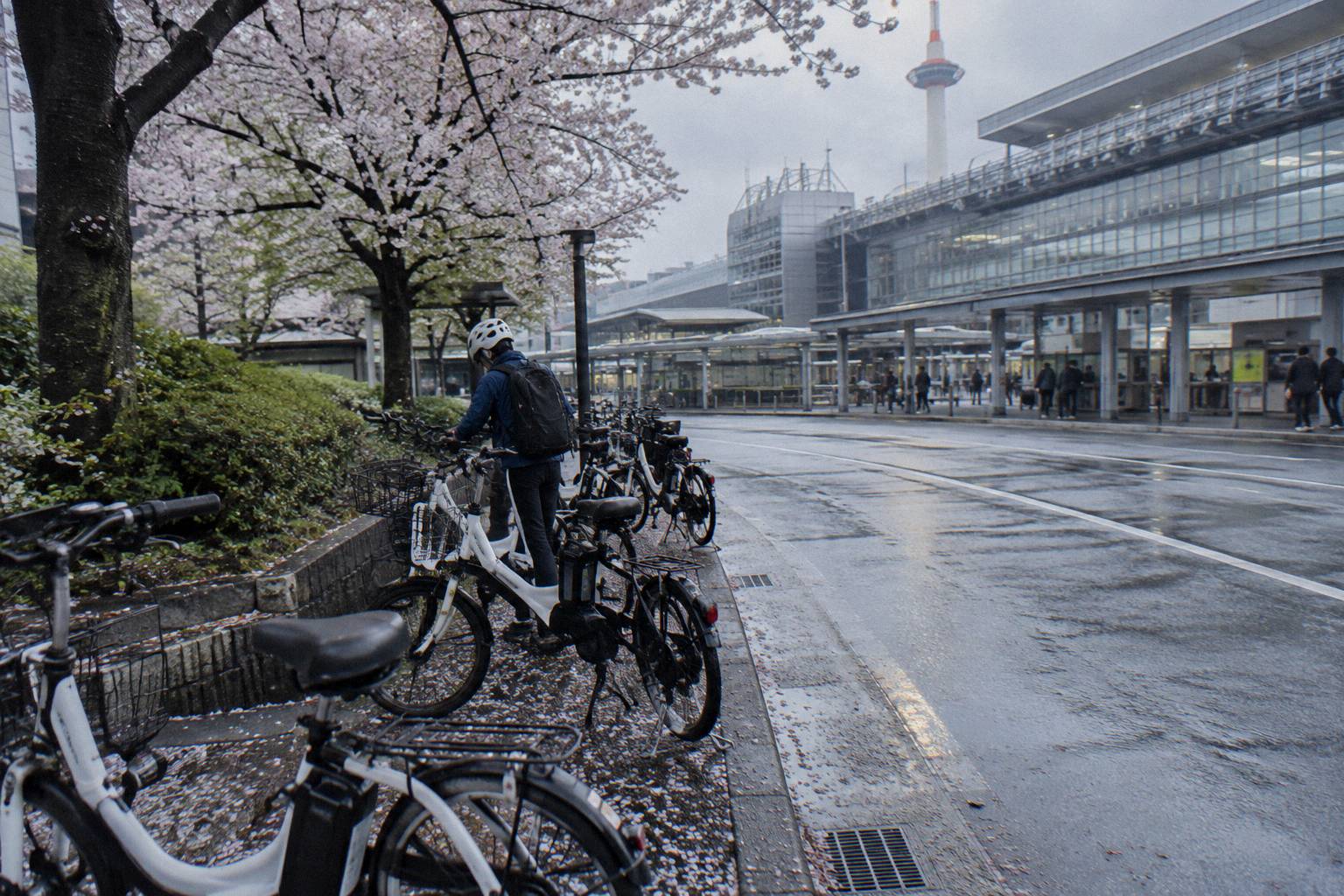
How Do Half-Day And Full-Day Spring Rides Compare?
The roster splits spring cleanly into two formats: half-day rides of 3 to 4 hours from ¥13,500 to ¥16,000 per person, and the full-day Grand Loop at 7 to 8 hours from ¥26,000 per person with lunch and admission fees included. Half-day rides suit visitors stacking blossom, temples and food into short stays; the full-day ride suits a one-and-done Kyoto day.
Minimum ages differ, which matters for family groups; the family angle is covered in cycling with kids.
The full-day Grand Loop (rated 5.0 from 596 reviews, minimum age 16) includes e-bike, light lunch, snacks and admission fees across five sites. Against two separate half-day bookings, it consolidates a day at a single price; against one half-day ride, it costs more and commits the whole day. The trade-offs by format run through the private or small group comparison and the full-day loop guide.
What each spring format puts on the table:
| Ride | From price | Duration | Named inclusions |
|---|---|---|---|
| Silver Pavilion, Philosopher's Path | ¥14,500 per person | 4 hours | E-bike rental, landing and facility fees, guide |
| Higashiyama Heritage Ride | ¥13,500 per person | 4 hours | Kiyomizu-dera and Ginkaku-ji entrance, electric bicycle |
| Early Bird Bamboo Forest Ride | ¥16,000 per person | 3 hours to 4 hours | Guide, bottled water, Cannondale multi-speed bicycle, helmet |
| Full-Day E-Bike, Lunch Included | ¥26,000 per person | 7 hours to 8 hours | E-bike, light lunch, snacks, bottled water, helmet, admission fees |
What Trips People Up Before You Book
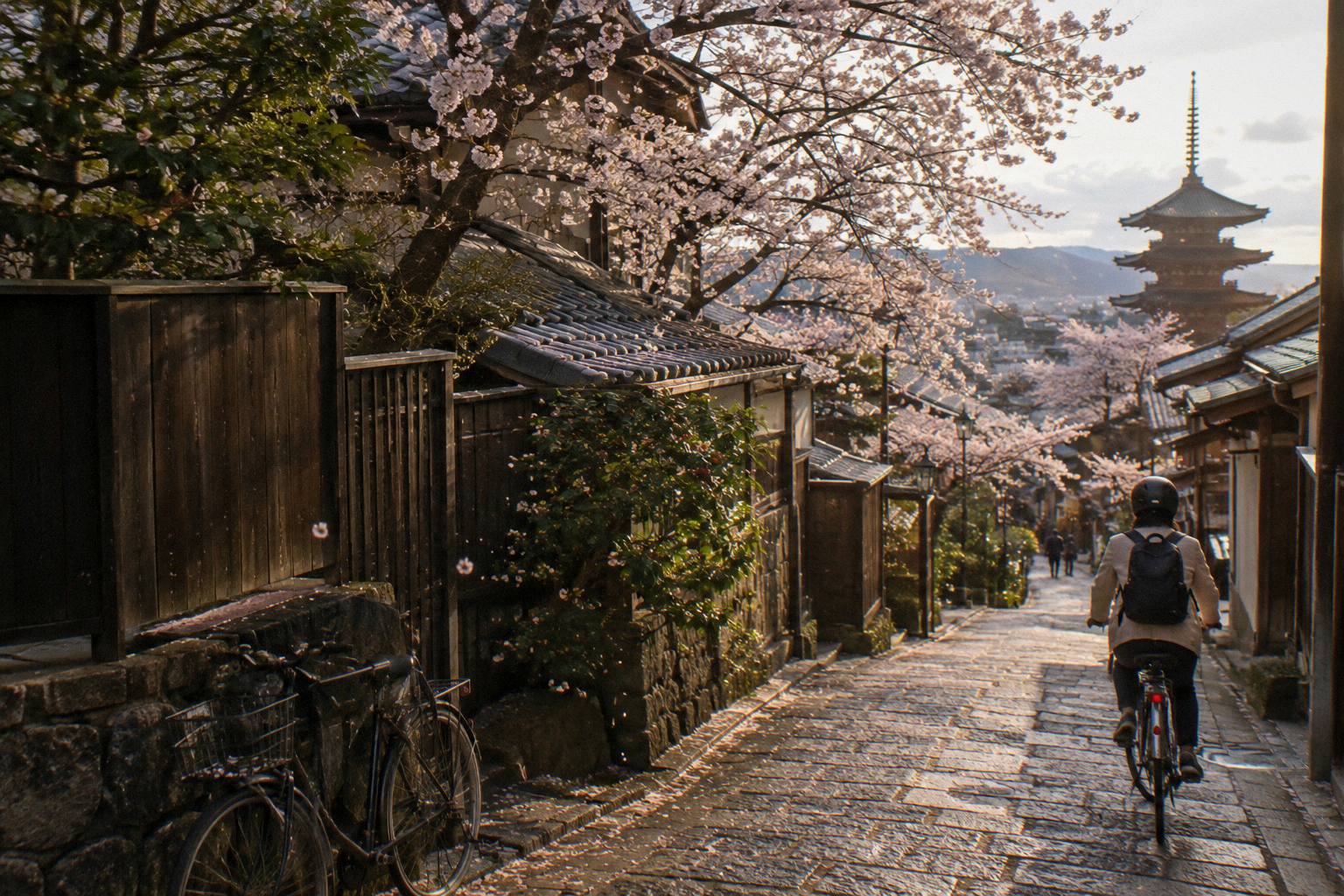
The common spring mistakes are booking a fixed date and refusing to move it, assuming the observatory date describes every tree in the city, forgetting that Ginkaku-ji's fee doubled on 1 April 2026, and treating a ride's e-bike as automatic when some products make it an upgrade. Each one is avoidable with a cancellable booking and five minutes with the product details.
The first mistake is the expensive one. The record range spans weeks, and a rider who books 4 April and will not budge is betting on a normal year. Free cancellation up to 24 hours before start exists on every ride discussed here; use it. The second mistake follows from the first: the observatory tracks a reference tree, and districts vary around it, so do not treat the announcement as a citywide switch.
The third is small but real: budget visitors who priced Ginkaku-ji at 500 yen from an older guide will now pay 1,000 yen at the gate. And the fourth catches riders who assume every ride is electric: the Early Bird Bamboo Forest Ride includes a Cannondale multi-speed bicycle, with the e-bike upgrade excluded from the base price and needing an advance request, subject to availability. Ask the operator before the booking day if an e-bike is essential to your plan.
Common Questions About Cherry Blossom Riding
When Is Cherry Blossom Season In Kyoto?
The Kyoto observatory's 1991-2020 normals put flowering at 26 March and full bloom at 4 April. In 2026 flowering came 23 March with full bloom 30 March; in 2025, 27 March and 5 April. The record range runs from 16 March to 9 April for flowering, so treat late March to mid April as the window rather than a fixed week.
Can I Book A Ride For Cherry Blossom Season In Advance?
Yes, and advance booking makes sense in spring because demand concentrates into a few weeks. Every ride in this guide carries free cancellation up to 24 hours before start, so you can book a date now and move it if the bloom shifts. Check availability on your chosen date before comparing alternatives.
Which Guided Ride Covers The Philosopher's Path?
"Kyoto E-Bike Tour: The Silver Pavilion & Philosopher's Path" (Silver Pavilion, Philosopher's Path) runs 4 hours from ¥14,500 per person, rated 5.0 from 322 reviews, minimum age 12, with e-bike rental and guide included. The Silver Pavilion, Philosopher's Path corridor is the city's classic blossom area, and the ride puts you there with a guide.
How Much Rain Should I Expect In Blossom Season?
March averages 106.2 mm and April 117.0 mm at the Kyoto station, per the Japan Meteorological Agency normals. That is moderate rainfall spread across the month, and well below July's 223.6 mm. A cancellable ride plus a rain layer covers most of the risk.
What Does Ginkaku-Ji Cost To Enter?
1,000 yen for adults and 500 yen for children since 1 April 2026, when the adult fee doubled from 500 yen. Hours are 8:30 to 17:00 from 1 March to 30 November. The Higashiyama Heritage Ride includes both Kiyomizu-dera and Ginkaku-ji entrance fees in its price.
Do I Need A Helmet For A Spring Ride?
Helmets have been an effort duty for every cyclist of every age since 1 April 2023, with no fine attached. Every ride discussed in this guide names a helmet as included, so on a guided ride the requirement is handled for you.