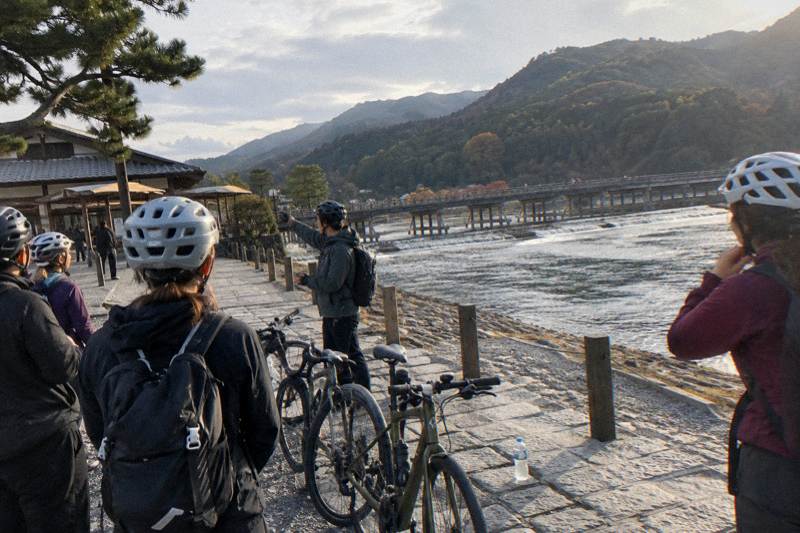
Arashiyama By Bike: Bamboo Grove, Togetsukyo And The River Ride
Arashiyama combines the bamboo grove, Togetsukyo Bridge and Tenryu-ji in one compact district. Here is how the guided rides that cover it differ, what they cost, and what to arrange before you go.
Short answer
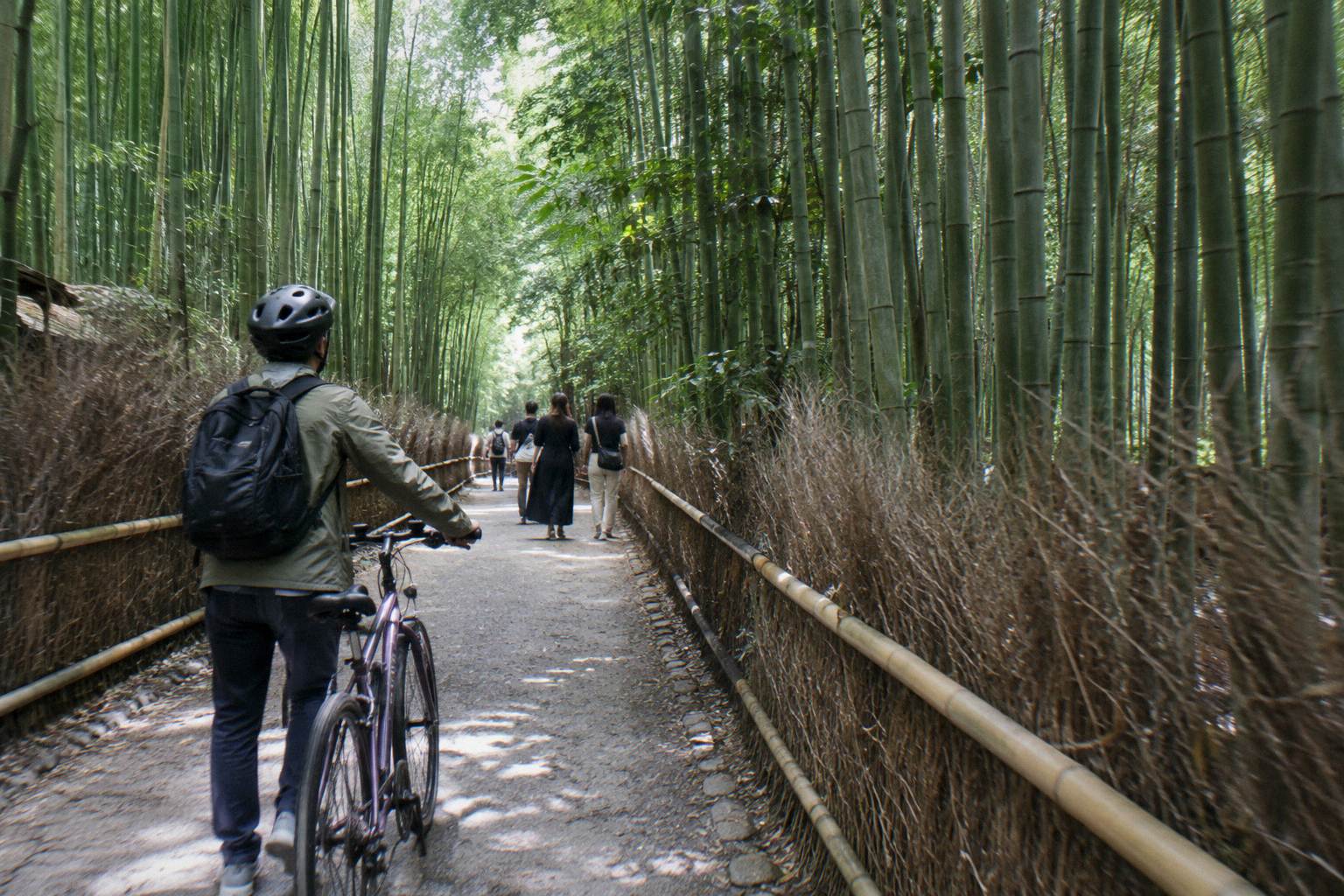
The early-morning Arashiyama ride, the Kyoto Bamboo Forest & Hidden Gems: Early Bird Easy Bike Tour, runs 3 to 4 hours from ¥16,000 per person, rated 5.0 from 773 reviews, minimum age 10. A full-day e-bike alternative costs from ¥26,000 per person and adds lunch and admission fees. The bamboo grove itself is free to walk; Tenryu-ji garden is 500 yen.
Arashiyama sits at the western edge of Kyoto, where the Katsura River runs past Arashiyama Mountain and the district's bamboo grove, Togetsukyo Bridge and Tenryu-ji temple cluster within a short ride of one another. If you want the grove and the river in one outing rather than three separate train trips, the Arashiyama and bamboo rides in this site's roster are built for exactly that pairing, and this page explains how they differ before you book anything.
| Fact | Detail |
|---|---|
| Bamboo grove (Chikurin no Michi) | Public path, free to walk |
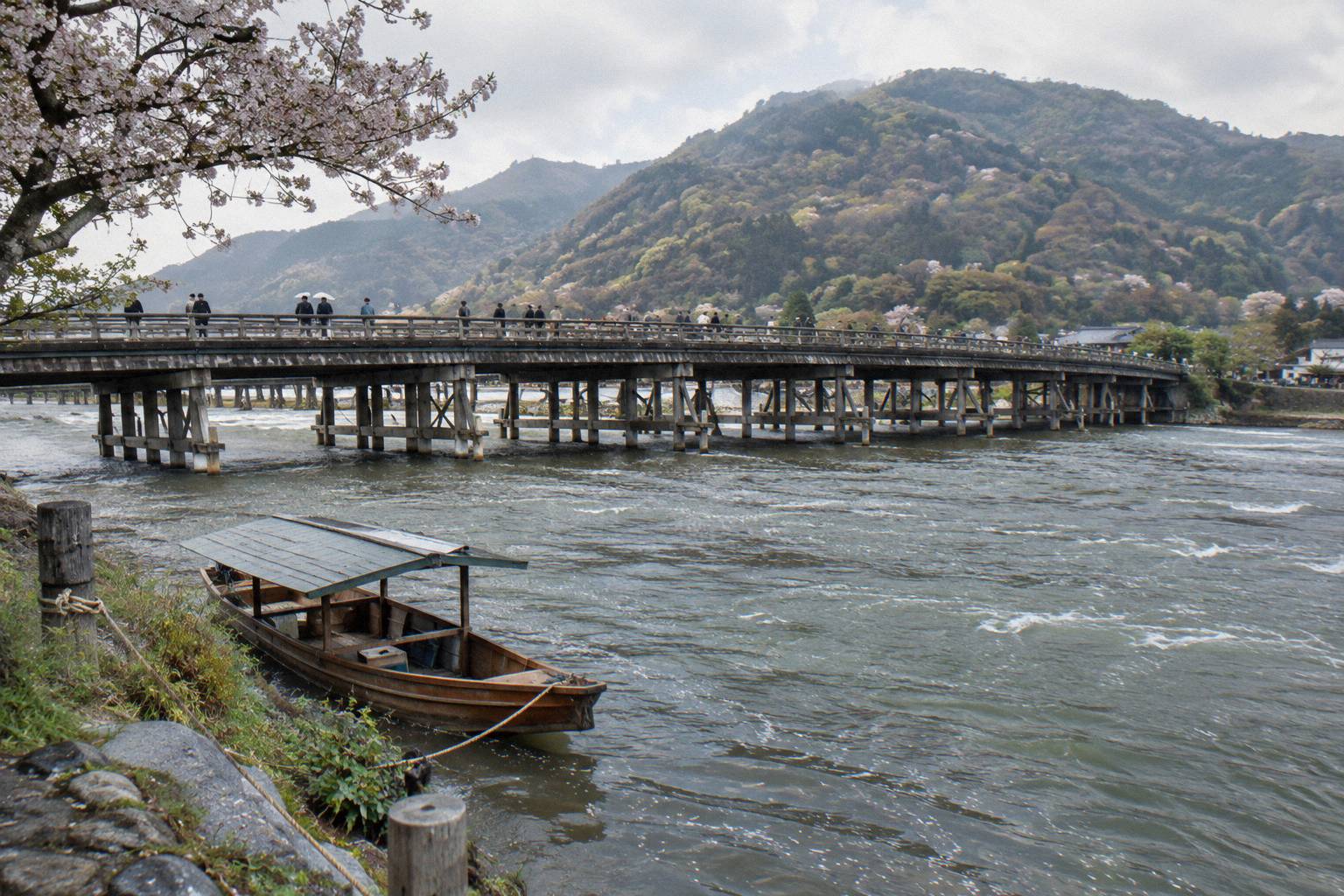
| Togetsukyo Bridge | Landmark of western Kyoto's Arashiyama District for over four hundred years, spanning the Katsura River in front of Arashiyama Mountain |
| Tenryu-ji garden | 500 yen (high school and older), 300 yen (elementary and middle school), preschool free; buildings add 300 yen |
| Tenryu-ji hours | 8:30 to 17:00, last admission 16:50 |
| Early Bird Bamboo Forest Ride | From ¥16,000 per person, 3 to 4 hours, rated 5.0 from 773 reviews, minimum age 10 |
| Full-Day E-Bike, Lunch Included | From ¥26,000 per person, 7 to 8 hours, rated 5.0 from 596 reviews, minimum age 16 |
| Cancellation | Free cancellation up to 24 hours before start on both rides |
| Helmets | An effort duty for every cyclist of every age since 1 April 2023, with no fine attached |
What An Arashiyama Bike Ride Actually Covers
A guided Arashiyama ride links the bamboo grove, Togetsukyo Bridge and the riverside into one moving visit instead of three walks between stations. The Early Bird Bamboo Forest Ride (Kyoto Bamboo Forest & Hidden Gems: Early Bird Easy Bike Tour) runs 3 to 4 hours from ¥16,000 per person, rated 5.0 from 773 reviews, with a Cannondale multi-speed bicycle, helmet, bottled water and a bilingual English-speaking guide included. The grove itself is free to walk.
The mechanics are simpler than most first-time visitors expect. You ride with a guide, the bicycle and helmet come with the booking, and the parts of Arashiyama that are not bookable at all, the public bamboo path and the bridge, are simply stops on the route. The only fixed cost inside the district is Tenryu-ji, where the garden is 500 yen for high school age and older, 300 yen for elementary and middle school students, and free for preschool children, with the buildings adding 300 yen.
What you do not need to arrange is the bike itself. The Early Bird ride names a comfortable, well-maintained Cannondale multi-speed bicycle in its inclusions, alongside bottled water and a native English-speaking bilingual guide. Hotel pick-up and drop-off are excluded, and an e-bike upgrade carries an extra fee and needs an advance request, subject to availability. Gratuities are optional.
The district rewards this compressed approach because its pieces sit close together. Togetsukyo Bridge spans the Katsura River in front of Arashiyama Mountain, per the Kyoto Tourism page on Togetsukyo Bridge, which records it as a landmark of western Kyoto's Arashiyama District for over four hundred years. The grove path and the temple sit on the same side of the river, and a guide who knows the sequence keeps the stops in an order that suits the timing of your booking.
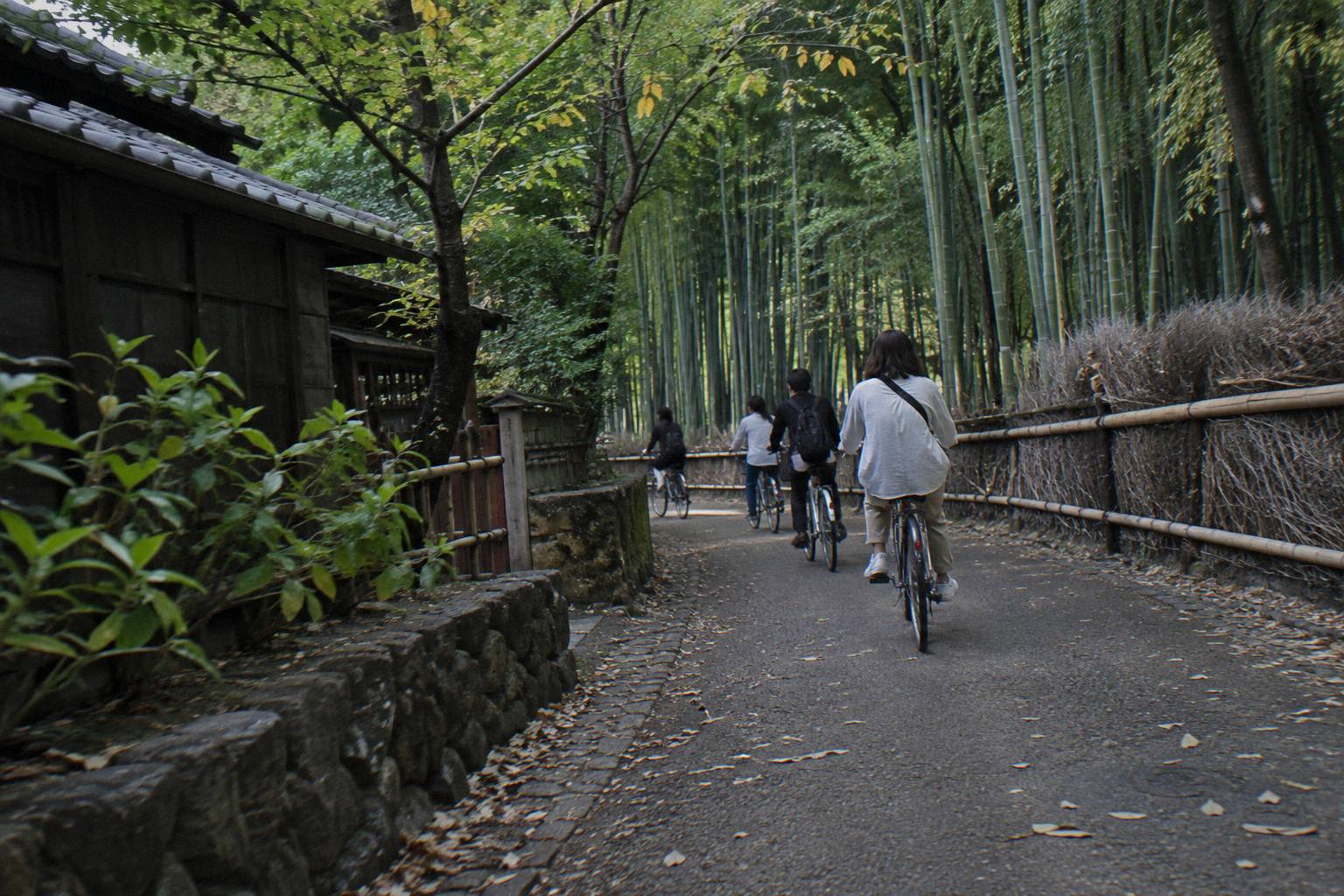
One planning point that separates Arashiyama from the rest of Kyoto: the headline sights here are either free or cheap. The grove costs nothing, the bridge costs nothing, and Tenryu-ji tops out at 800 yen if you add the buildings to the garden. Your real budget line is the ride itself, which is why the sections below compare the roster products directly rather than talking around prices.
Is Arashiyama Worth Doing By Bike?
Yes, if you want the grove, the bridge and Tenryu-ji in a single morning or afternoon. The guided alternative to riding is a sequence of walks and trains, and the district's sights are close enough that a bicycle covers them without rushing. The 5.0 from 773 reviews rating on the Early Bird Bamboo Forest Ride, at from ¥16,000 per person for 3 to 4 hours, reflects a format that has been bought and reviewed at real volume.
The case for the bicycle is structural. Arashiyama's three anchors form a rough triangle: the grove path in the north of the district, Tenryu-ji beside it, and Togetsukyo Bridge down at the river. On foot that is a loop of maybe a few hours with pauses; on a bike the travel between stops compresses to minutes, and you keep the walking for the places where walking is the point, the grove path itself and the temple garden.
The case against is equally plain. If your whole interest is the bamboo grove and nothing else, a train to the district and a walk does the job for the price of the fare. A ride earns its fee when the bridge, the temple and the riverside are also on your list, or when you want a guide who sequences the stops and supplies the bicycle, helmet and water. If you are weighing the general question of a guide versus riding alone, the guided or self-guided cycling in Kyoto guide covers the trade-offs citywide.
Arashiyama also has a timing problem that a guided morning ride answers neatly. The district is one of Kyoto's most visited, and the grove path is a public path with no gate, so it fills during the middle of the day. An early start is the standard response, and the roster's Arashiyama product is built around exactly that: the Early Bird Bamboo Forest Ride begins in the morning slot and finishes within 3 to 4 hours. The best time of day for cycling in Kyoto guide goes deeper on timing across the city's districts.
Whichever direction you lean, book the ride before you book anything else in the district. The Early Bird ride, the one roster product that puts Arashiyama and the grove at the centre of its itinerary, has a finite number of bicycles per departure, and its 773 reviews suggest the morning slots are the ones that fill. You can check dates on the Early Bird Bamboo Forest Ride page, or check availability for your travel dates.
Which Guided Rides Reach Arashiyama?
Three roster formats touch Arashiyama. The Early Bird Bamboo Forest Ride is the dedicated option: 3 to 4 hours, from ¥16,000 per person, minimum age 10. The Full-Day E-Bike, Lunch Included (Bike Kyoto's Grand Loop) covers Arashiyama among five sites over 7 to 8 hours from ¥26,000 per person, minimum age 16, with a light lunch, snacks, admission fees and an e-bike included. A third way in pairs Arashiyama with a contrasting district.
The dedicated ride is the purest expression of the format. Kyoto Bike Tour operates it with a Cannondale multi-speed bicycle, helmet, bottled water and a native English-speaking bilingual guide, and the route concentrates on the grove, the river and the hidden lanes of the district rather than stretching across the city. With 3 to 4 hours it fits a morning and leaves the afternoon free, which matters if Arashiyama is one stop on a full Kyoto day rather than the whole day.
The full-day alternative trades focus for range. Bike Kyoto's Grand Loop runs 7 to 8 hours and strings five top sites together, with Arashiyama among them, and its inclusions are broader: a light lunch, snacks, bottled water, helmet, admission fees and an electric-assist e-bike. Hotel pick-up and drop-off are excluded, and a multi-speed pedal bike is available on request at no extra charge if you would rather not ride electric. It carries a 5.0 from 596 reviews rating at from ¥26,000 per person, minimum age 16, so it excludes younger children where the Early Bird ride admits them from age 10.
A third option is contrast. Arashiyama in the west pairs well with a southern district visited on a different day or a different ride, and the South Kyoto: E-Bike Highlights & Local Cultural Experiences (the Fushimi Inari, Sento Stop ride) offers exactly that: a 4-hour e-bike ride from ¥13,500 per person with a reusable water bottle, a fox-shaped ema, amazake and a towel for the sento bath stop included. It has 10 reviews, so no rating is quoted here. If Fushimi Inari is on your list alongside Arashiyama, the Fushimi Inari by bike route guide covers that district separately.
Choosing between the two main options comes down to two questions. First, do you want one district deeply or five sites broadly? Second, who is riding? The minimum age is 10 on the early bird ride and 16 on the full-day loop, and the loop's lunch and e-bike inclusions suit a rider spending the whole day in the saddle. Prices vary by date and group, and the booking page shows the price for your date.
One more practical note on format. The early bird ride's standard bicycle is a multi-speed Cannondale; the e-bike is an upgrade that costs extra and depends on availability, so request it in advance if you want it. The full-day loop includes the e-bike by default. Riders deciding between pedal and electric more generally can read the e-bike or regular bike in Kyoto guide for the rider-fit argument.
How Much Does An Arashiyama Ride Cost?
The dedicated Arashiyama ride costs from ¥16,000 per person for 3 to 4 hours. The full-day loop that includes Arashiyama costs from ¥26,000 per person for 7 to 8 hours, with lunch and admission fees included. Inside the district, the bamboo grove is free, Togetsukyo Bridge is free, and Tenryu-ji is 500 yen for the garden with 300 yen more for the buildings. The booking page shows the price for your date.
The two ride prices are from-prices, meaning the figure a booking opens at, and the actual charge moves with the date and group you pick. What you get for the difference between the two tiers is mostly time and inclusion depth: the full-day loop adds roughly four hours, a light lunch, snacks, admission fees and an e-bike, while the early bird ride supplies a Cannondale multi-speed bicycle, helmet, water and a bilingual guide for a shorter outing.
| Product | From price (per person) | Duration | Minimum age | Rating | Included |
|---|---|---|---|---|---|
| Early Bird Bamboo Forest Ride | ¥16,000 | 3 hours to 4 hours | 10 | 5.0 from 773 reviews | Cannondale multi-speed bicycle, helmet, bottled water, bilingual guide |
| Full-Day E-Bike, Lunch Included | ¥26,000 | 7 hours to 8 hours | 16 | 5.0 from 596 reviews | E-bike, light lunch, snacks, admission fees, helmet, bottled water, guide |
| Fushimi Inari, Sento Stop | ¥13,500 | 4 hours | 1 | 10 reviews | E-bike, reusable water bottle, fox-shaped ema, amazake, sento towel |
Add the in-district costs on top where they apply. The grove path is free and has no gate. The bridge is free. Tenryu-ji, if your ride's route includes it and admission is not named as included, charges 500 yen for the garden at high school age and older, 300 yen for elementary and middle school, nothing for preschool, and 300 yen extra for the buildings, per the Tenryu-ji visitor page. The full-day loop names admission fees among its inclusions; the early bird ride does not, so carry a few hundred yen in coins.
Budget for the exclusions too. Neither ride includes hotel pick-up or drop-off. The early bird ride's e-bike upgrade is an extra fee, requested in advance if available. Gratuities are optional on both. A reasonable planning figure for a day built around the early bird ride is the ride price plus a temple ticket plus lunch afterwards in the district; nothing in Arashiyama itself will surprise you with a large fee.
What To Expect At The Bamboo Grove And Togetsukyo
The bamboo grove, Chikurin no Michi, is a public path and free to walk, with no gate and no ticket. Togetsukyo Bridge has been a landmark of western Kyoto's Arashiyama District for over four hundred years and spans the Katsura River in front of Arashiyama Mountain. Neither stop is a bookable attraction; a ride includes them as stops, not as tickets.
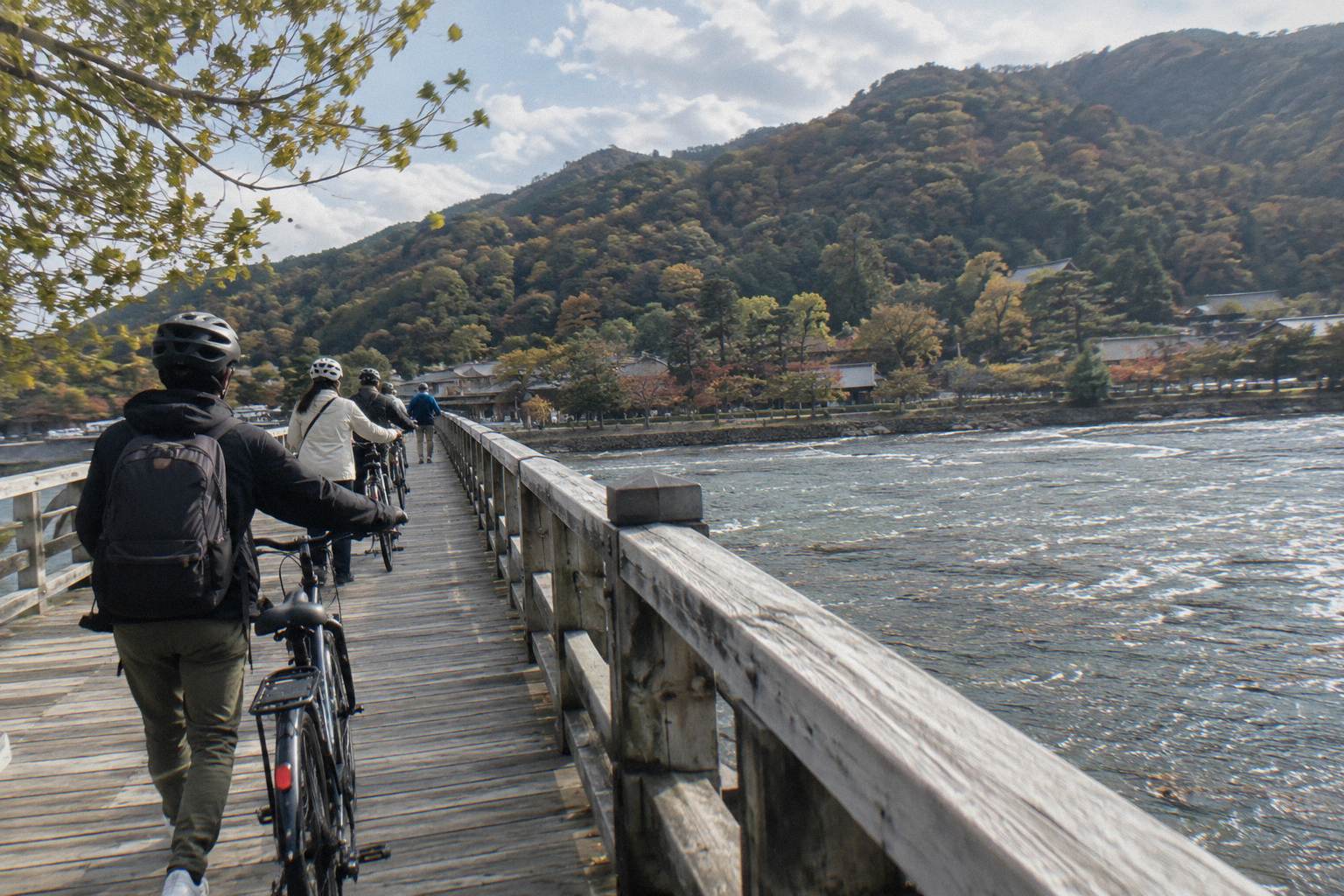
The grove is the reason most people come to Arashiyama, and its simplicity catches visitors out. There is no entrance to find, no booth, no fee. The path is public, and the experience is the walking of it, tall bamboo close on both sides. Because it is public and free, nothing controls how many people are on it at once, which is the whole argument for an early-start ride: the Early Bird Bamboo Forest Ride is scheduled so that its grove time falls in the morning. Other pages covering the same trip are gathered on Kyoto Bike Tours.
Togetsukyo Bridge is the district's second anchor. The wooden bridge spans the Katsura River in front of Arashiyama Mountain, and Kyoto Tourism records it as an Arashiyama landmark for over four hundred years. It functions as the crossing point and the viewpoint: the river runs below, the mountain rises behind, and the district's lanes fan out from both ends of it. A ride crosses it, stops at it, and uses it to move between the grove side of the district and the river's southern bank.
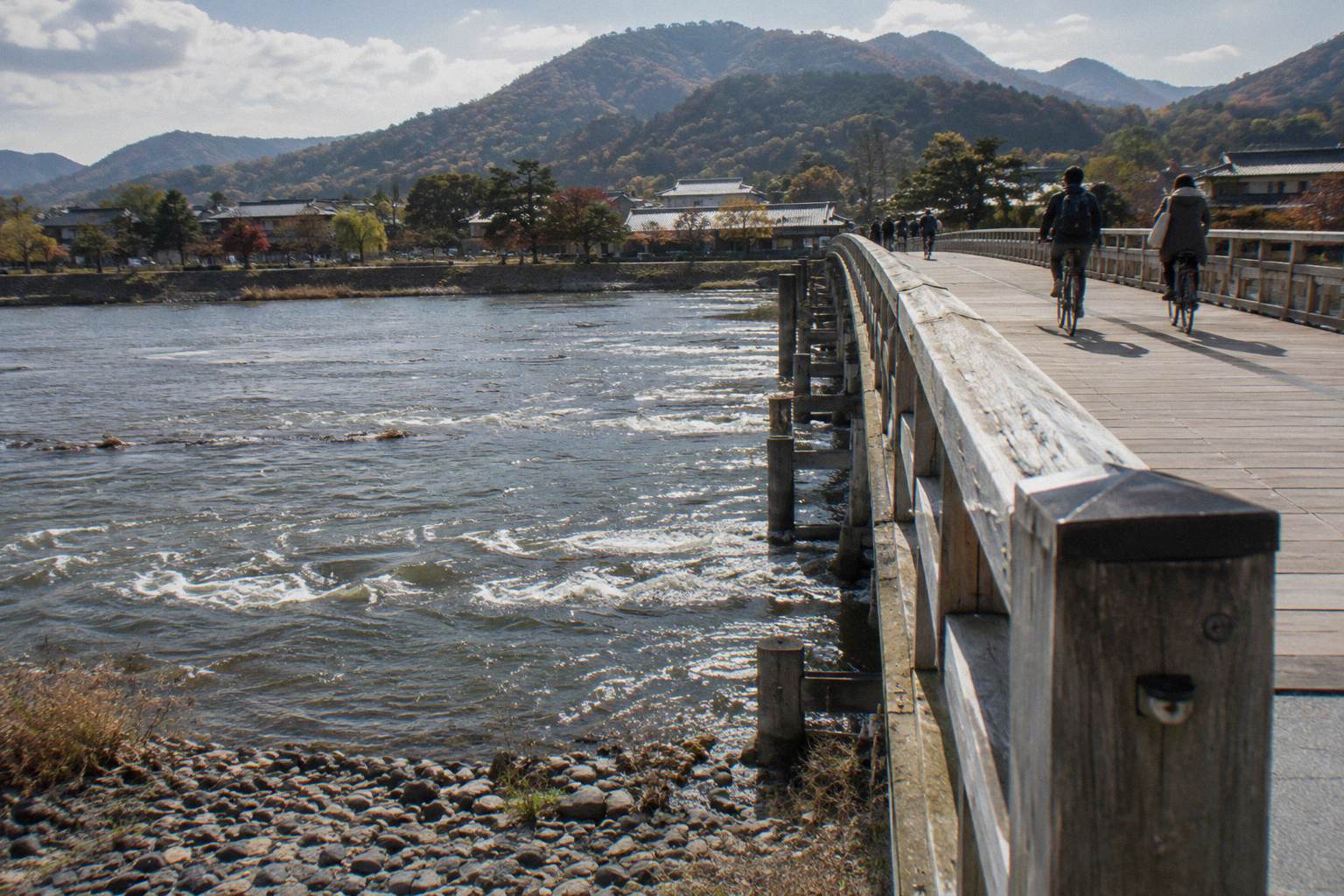
Neither stop needs long. The grove is a path you walk once, slowly; the bridge is a crossing with a view. What fills the rest of a 3 to 4 hour ride is the connective tissue: the lanes between the grove and the river, the guide's commentary at each stop, and Tenryu-ji if the route includes it. That ratio, short famous stops and plenty of local street in between, is the actual product a good Arashiyama ride sells.
Riders with a spare half day after the ride can extend the river theme: the district sits on the Katsura, and Kyoto's other great waterway, the Kamo, has its own riding considerations covered in the Kamo River cycling route guide. Keep the two days separate in your planning; they are different districts with different logics.
If the full-day loop above is the version that suits, note its shape before booking: five top sites across 7 to 8 hours, minimum age 16, e-bike and light lunch included, from ¥26,000 per person. It treats Arashiyama as one movement within a longer composition rather than the whole concert.
How Does Tenryu-ji Fit Into An Arashiyama Ride?
Tenryu-ji sits within the Arashiyama cluster and charges for entry where its neighbours do not. The garden costs 500 yen for high school and older, 300 yen for elementary and middle school, and is free for preschool children; the buildings add 300 yen. Hours are 8:30 to 17:00 with last admission at 16:50. The full-day loop names admission fees as included; the early bird ride does not.
Tenryu-ji is the temple of the district, a UNESCO-listed site whose garden is the main draw. The fee structure is simple: garden only at 500 yen for adults in the high-school-and-older band, 300 yen for elementary and middle school students, free for preschool, and 300 yen on top to enter the buildings. The temple is open 8:30 to 17:00 with last admission at 16:50, so a morning ride that reaches the temple by mid-morning has hours of margin.
The timing interlocks neatly with the early-ride logic. The temple opens at 8:30, the grove is free and un gated, and the bridge is always there. A ride that starts early can take the grove first, while it is quiet, then the temple once it has opened, then the bridge as the district fills. That sequencing is exactly what a guide is for, and it is the difference between riding the district and merely being in it.
| Stop | Cost | Hours | Notes |
|---|---|---|---|
| Bamboo grove (Chikurin no Michi) | Free | No stated hours | Public path, no gate |
| Togetsukyo Bridge | Free | No stated hours | Over four hundred years old; spans the Katsura River in front of Arashiyama Mountain |
| Tenryu-ji garden | 500 yen adults, 300 yen school age, preschool free | 8:30 to 17:00, last admission 16:50 | Buildings add 300 yen |
One caution on the temple row: a guided ride's stop may be the garden only, and the buildings' 300 yen may or may not be part of the visit, so ask the guide or check the route description before assuming the interiors are included. If the interiors matter to you, budget the extra coins and the extra minutes.
For a rider who prefers a temple-dense day that skips Arashiyama's crowds entirely, the Higashiyama Heritage Ride (Explore Heritage and Landmarks of Kyoto with E-Bike Ride) covers Kiyomizu-dera and Ginkaku-ji instead, from ¥13,500 per person for 4 hours with both entrance fees and the electric bicycle included; it has 7 reviews, so no rating is claimed. Ginkaku-ji's own fee rose to 1,000 yen for adults on 1 April 2026, and that price is included in the ride. The Higashiyama cycling route guide covers that district in depth.
When Should You Ride Arashiyama?
Time of day first: an early start is the whole design of the dedicated ride, and the morning slot exists because the grove is a free public path that fills later. Time of year second: Kyoto's cherry blossom normally reaches full bloom on 4 April, maple colouring is normally at its official marker on 5 December, July is the wettest month with 223.6 mm, and August is the hottest at a mean of 28.5 °C.
- Budget Fare, Hidden Alleys¥11,000
- Crowd-Free E-Bike Ride¥13,000
- Higashiyama Heritage Ride¥13,500
- Fushimi Inari, Sento Stop¥13,500
- Morning Ride From Station¥14,000
- Silver Pavilion, Philosopher's Path¥14,500
- Backstreets, 5 To 6 Hours¥15,000
- Palace, Castle And Temples¥16,500
The seasonal picture comes from the Japan Meteorological Agency's Kyoto station, whose 1991 to 2020 normals show a clear shape: cool, dry winters (January averages 4.8 °C and 53.3 mm of rain), a mild and getting-warm spring (April 14.4 °C), a hot wet midsummer, and a settled, cool autumn (November 12.5 °C and 73.9 mm). The JMA Kyoto monthly normals hold the full table.
| Month | Mean C | Daily high C | Rain mm |
|---|---|---|---|
| January | 4.8 | 9.1 | 53.3 |
| April | 14.4 | 20.1 | 117.0 |
| July | 27.3 | 32.0 | 223.6 |
| August | 28.5 | 33.7 | 153.8 |
| November | 12.5 | 17.3 | 73.9 |
The blossom and leaf dates are the observatory's, and they are normals, not promises. Full bloom in Kyoto averages 4 April, though in 2026 it arrived on 30 March and in 2025 on 5 April. Maple colouring at the observatory's official marker tree averages 5 December, with a record range from 10 November to 20 December. Arashiyama is famous for both seasons, and the dates give you a planning window, nothing firmer. Weather, bloom and crowds decide what any single day delivers.
For riding comfort, the shoulder months win: March to May and October to November carry the mildest means and manageable rainfall. July's 223.6 mm makes it the wettest month, and August's 33.7 °C daily high, against a record daily maximum of 39.8 °C for the city, argues for a morning ride if summer is your only window. The rainy season runs roughly early June to mid July. The summer heat cycling guide and the rainy season cycling guide each cover their own season's tactics.
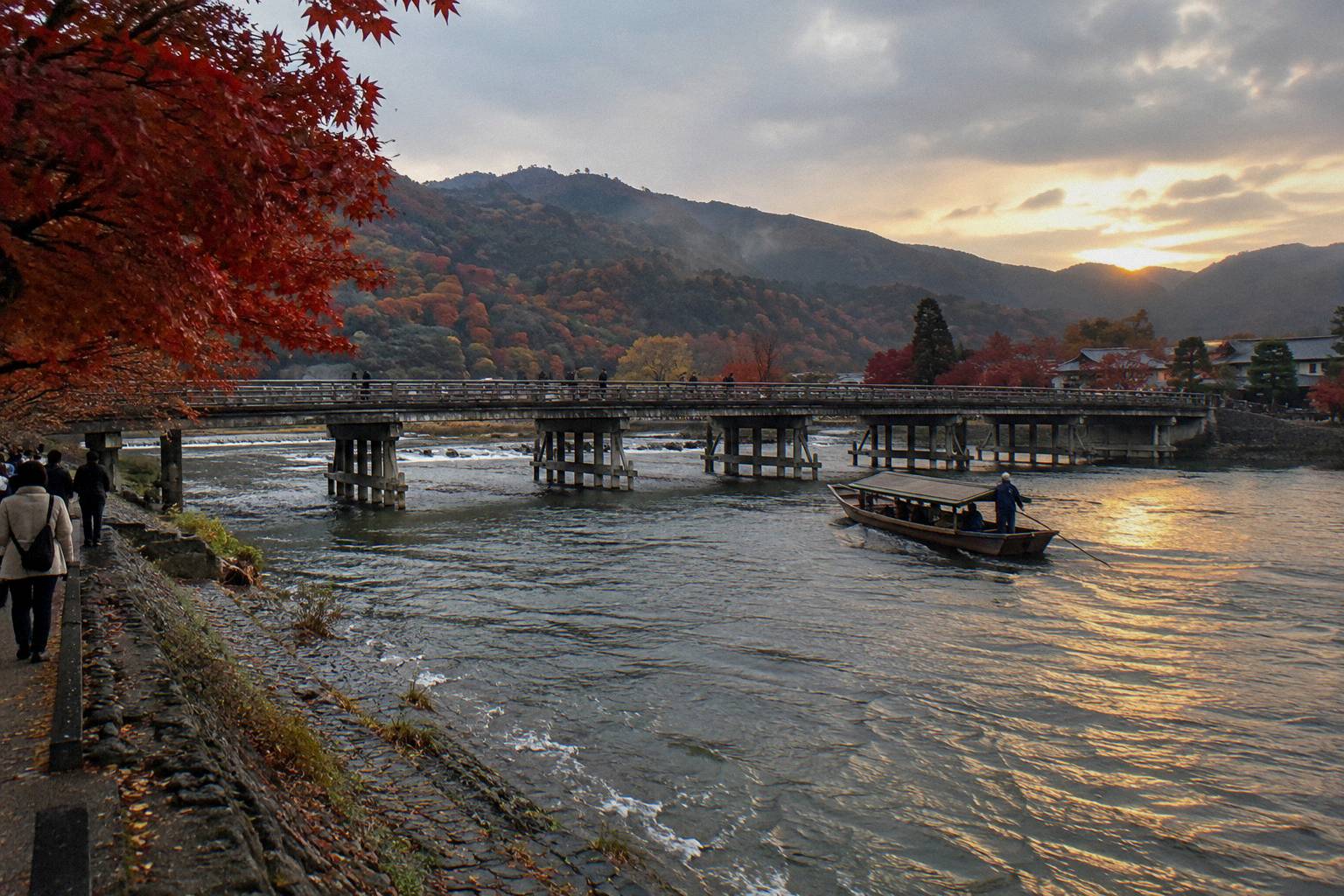
Seasonal timing also interacts with the roster. The early bird ride runs year-round in principle, but what it can promise about blossoms or leaves is nothing beyond the calendar; free cancellation up to 24 hours before start means a washout forecast costs you nothing if you change plans. The cherry blossom cycling guide and the autumn leaves cycling guide handle those two windows in detail.
If Arashiyama turns out to be the wrong fit for your dates, the Silver Pavilion ride above is a like-for-like swap: 4 hours, from ¥14,500 per person, rated 5.0 from 322 reviews, minimum age 12, with the e-bike rental, landing and facility fees and guide included, lunch excluded. Same shape of morning, different side of the city.
What Trips People Up Before You Book
The four common mistakes are: assuming temple admission is included when the ride does not name it; booking the full-day loop for a family that includes children under 16; expecting an e-bike on a ride whose standard bicycle is a pedal bike unless the upgrade is requested in advance; and parking or locking the bicycle carelessly, since Kyoto City removes illegally parked bicycles and charges 3,500 yen per bicycle to return one, holding it for four weeks.
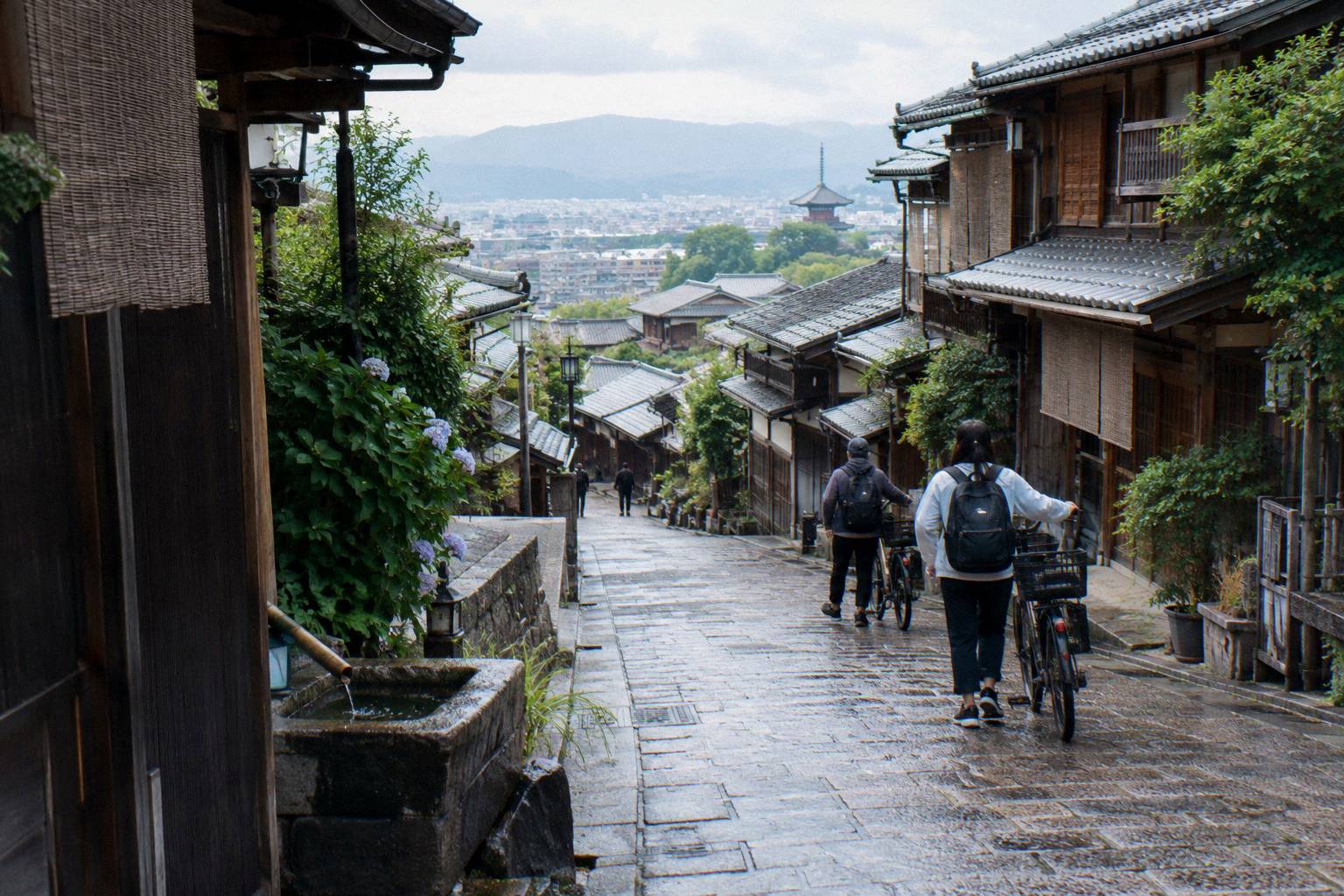
The admission mistake is the most expensive in friction, not money. The full-day loop names admission fees as included; the early bird ride does not, and its route touches a district where Tenryu-ji charges 500 yen for the garden. Carry coins, and check whether your chosen ride's description names the temple and its fee.
The age mistake excludes people at the gate. The full-day loop's minimum age is 16; the early bird ride's is 10. A family with a 12-year-old fits one product and not the other, and the booking page will not let the younger rider onto the full-day loop. Check minimum ages against your whole party before paying.
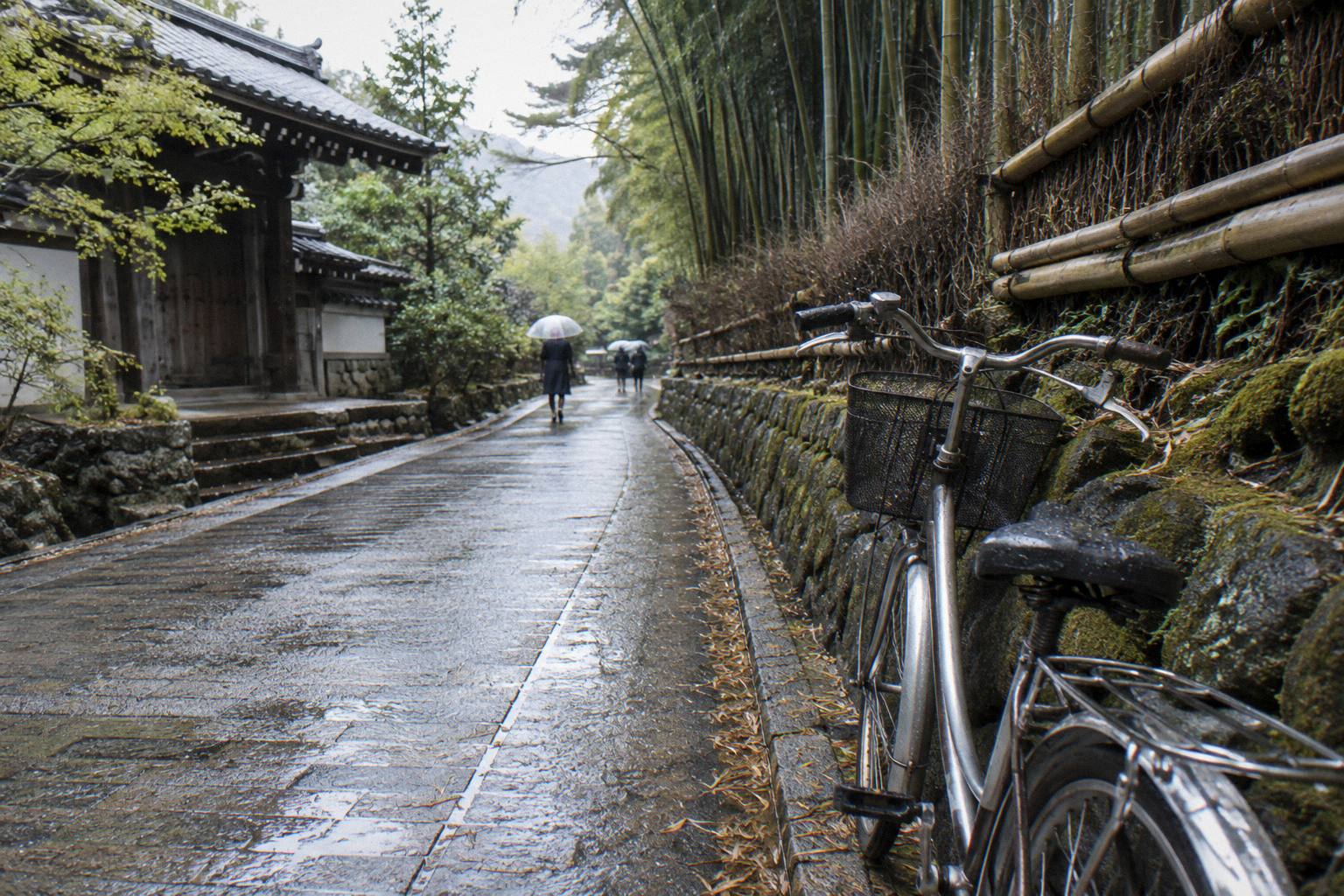
The equipment mistake is about expectations. The early bird ride's included bicycle is a Cannondale multi-speed; the e-bike is an upgrade with an extra fee, by advance request, if available. The full-day loop includes the e-bike and offers the pedal bike instead on request at no extra charge. Neither ride reads the same on this point, so match the product to the bike you actually want to ride.
The parking mistake carries a real penalty. Kyoto City's removal scheme covers nearly the whole city, and the Kyoto City page on removed bicycles states the 3,500 yen per bicycle return fee and the four-week holding period from the day after removal. On a guided ride the guide handles where the group parks, but riders who extend the day with a private rental afterwards should treat any spot outside a marked parking area as removable. The bike parking in Kyoto guide covers where bikes may legally stand.
Two smaller ones. First, helmets: since 1 April 2023 every cyclist of every age in Japan has an effort duty to wear one, with no fine attached, per the Kyoto Prefecture page on the helmet duty; both Arashiyama-area rides include a helmet, so wear it. Second, weather plans: free cancellation up to 24 hours before start is the rule on both products, so a bad forecast is a free decision, not a sunk cost. The rules for riding itself, fines included, sit in the Kyoto cycling rules guide.
Common Questions About Arashiyama Rides
How Long Does An Arashiyama Bike Ride Take?
The dedicated early bird ride runs 3 hours to 4 hours. The full-day loop that includes Arashiyama among five sites runs 7 hours to 8 hours. Both figures are the operator's stated durations.
Does The Bamboo Grove Cost Anything?
No. Chikurin no Michi is a public path with no gate and no fee. The only ticketed stop in the district is Tenryu-ji, where the garden is 500 yen for high school and older and the buildings add 300 yen.
Is Arashiyama Suitable For Children On A Bike Ride?
The Early Bird Bamboo Forest Ride sets a minimum age of 10. The full-day loop sets a minimum age of 16, so it does not admit younger riders. Match the product to the youngest member of your party before booking.
Is An E-Bike Included On Arashiyama Rides?
On the full-day loop, yes: the electric-assist bike is included, with a pedal bike available instead on request at no charge. On the early bird ride, no: the standard bike is a Cannondale multi-speed, and the e-bike is an extra-fee upgrade by advance request, if available.
Can I Cancel If The Weather Turns?
Both the early bird ride and the full-day loop carry free cancellation up to 24 hours before start. Check the booking calendar for your date before the cutoff rather than after it.
Do I Need To Book An Arashiyama Ride In Advance?
Advance booking is the practical answer: the early bird ride has a fixed number of bicycles per departure and carries 773 reviews, which suggests steady demand for its morning slots. The question of how far ahead applies citywide is covered in the blog post on whether you should book a Kyoto ride in advance.