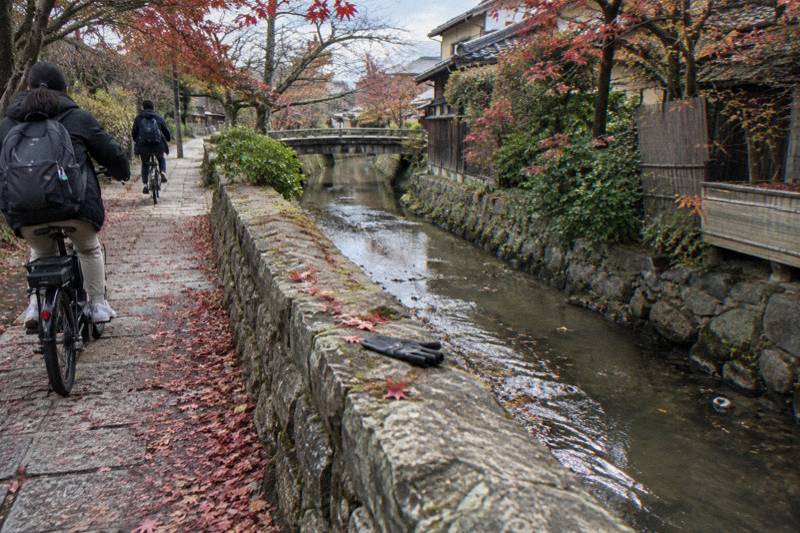
Autumn Leaves By Bike In Kyoto: Routes, Timing And Crowds
Kyoto's autumn colour runs to an official calendar, not a rumoured one, and the difference shapes every booking decision from October to December.
Short answer
Kyoto's maple colouring has a 1991-2020 normal of 5 December, ginkgo yellowing of 24 November and maple leaf-fall of 18 December, measured on observatory reference trees. November brings 73.9 mm of rain and a mean daily high of 17.3 °C. Dated rides on the roster run from ¥11,000 to ¥15,000 per person for four to five hour loops.
Kyoto's autumn is the most datable season in the city. The Kyoto Bike Tours roster covers dated e-bike departures that slot around the observatory's colour calendar, and this guide lines up the two: the official timing, the temple fees that rise in the foliage period, and the specific four and five hour rides that carry an autumn visit. The rides discussed below include the Fushimi Inari and sento e-bike loop from ¥13,500 per person, the Silver Pavilion and Philosopher's Path ride from ¥14,500 per person, and the UNESCO Zen temples loop with lunch from ¥15,000 per person. Start with the Fushimi Inari and sento ride if you want one booking to anchor the season.
| Fact | Detail |
|---|---|
| Maple colouring, normal 1991-2020 | 5 December (2025: 10 December) |
| Ginkgo yellowing, normal | 24 November (2025: 25 November) |
| Maple leaf-fall, normal | 18 December |
| Maple record range | 10 November 1976 to 20 December 2024 |
| November rain | 73.9 mm |
| November mean daily high | 17.3 °C |
| October rain | 143.2 mm |
| Tofuku-ji Hojo garden fee | 600 yen from 1 November 2026 |
| Helmet | Effort duty for every age since 1 April 2023, no fine |
When Do Kyoto's Autumn Leaves Actually Turn?
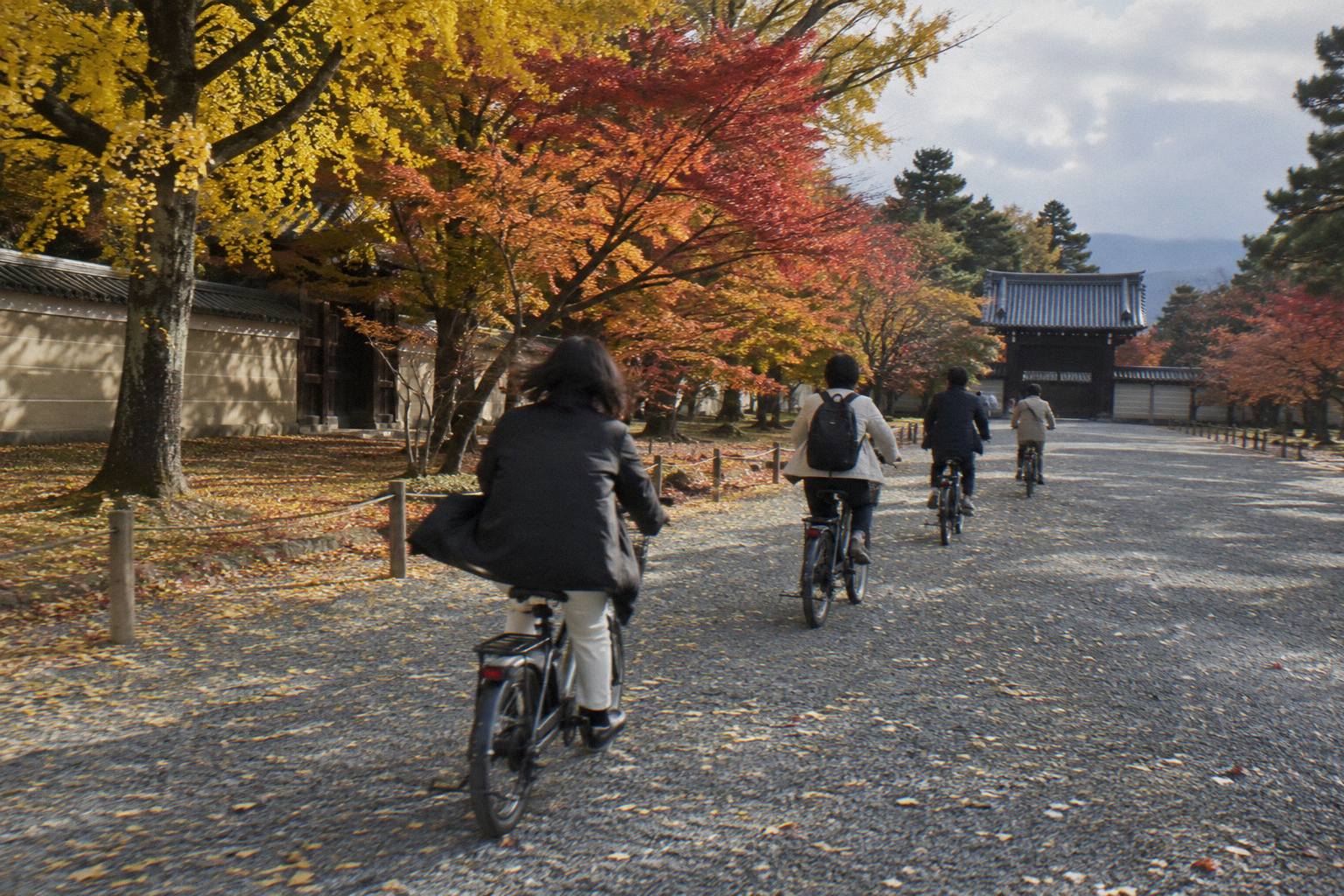
The official marker is the observatory's reference tree: maple colouring normally reaches its benchmark on 5 December, ginkgo yellowing on 24 November, and maple leaf-fall on 18 December. In 2025 the maple marker fell on 10 December. The record spread runs from 10 November 1976 to 20 December 2024, so any single date is a normal, never a promise.
Those figures come from the Japan Meteorological Agency's Kyoto observations, which track a defined reference tree the way other stations track first bloom. The marker is a citywide scientific benchmark. It is not an Arashiyama forecast, and no official page ties it to a specific district's best week. The practical reading: late November through mid December is when the normals cluster, and the earlier or later edges of the record range show how far a given year can drift.
Ginkgo runs on its own clock, about eleven days ahead of the maple marker in a normal year. Riders who visit in mid to late November are more likely to catch yellow than red, and the two colours overlap in the last week of November in an average season. In 2025 both markers landed close to their normals, ginkgo on 25 November and maple on 10 December, which shows the normals are a fair planning frame even in a single recent year. Whether any given tree on any given ride is at colour depends on the season, not the calendar, and operators run their schedules regardless.
This matters for booking because every ride on the roster carries free cancellation up to 24 hours before start. That structure suits a foliage trip: book the date you can travel, watch how the season develops, and keep the 24 hour window in mind if a cold snap or a warm stretch moves the colour away from your dates. For the climate context behind that decision, the summer heat cycling guide shows how far temperatures fall between August and November.
Is November A Good Month To Ride In Kyoto?
November is one of the driest riding months in the second half of Kyoto's year: 73.9 mm of rain against 143.2 mm in October, with a mean daily high of 17.3 °C and a mean of 12.5 °C. December drops further to 57.3 mm and a high of 11.6 °C. Those are 1991-2020 station normals, so they describe the month, not any particular day.
The contrast with October is the useful part. October still carries the tail of the wetter pattern, nearly double November's rainfall, while November combines low rain with a daily high that sits in comfortable riding territory by Kyoto standards. December is drier still but cooler, and the maple leaf-fall normal of 18 December marks the point where the colour season is ending on the reference tree rather than building. The monthly figures are from the Japan Meteorological Agency Kyoto monthly normals.
| Month | Rain (mm) | Mean (C) | Mean daily high (C) | Mean daily min (C) |
|---|---|---|---|---|
| October | 143.2 | 18.4 | 23.4 | 14.4 |
| November | 73.9 | 12.5 | 17.3 | 8.4 |
| December | 57.3 | 7.2 | 11.6 | 3.5 |
Dressing follows the table: November mornings sit near 8 °C on average while afternoons reach 17 °C, so layers matter more than any single jacket choice. The what to wear cycling guide covers that trade-off in detail. A morning departure and an afternoon departure in the same November week can feel like different seasons, which is one reason dated rides, rather than open rentals, suit foliage trips: the operator picks the window and you pick the day. December sharpens the same logic, with a mean daily minimum of 3.5 °C that puts gloves and a warm layer on the packing list for any ride that runs past mid afternoon.
What Does Autumn Foliage Access Cost At The Temples?
Tofuku-ji charges from 1 November 2026: 600 yen for the Hojo garden, 600 yen for Tsutenkyo bridge and Kaisando, rising to 1,000 yen during the autumn foliage period, with a combined ticket at 1,000 yen. Elsewhere the standard fees apply year-round: Kinkaku-ji 500 yen, Tenryu-ji's garden 500 yen, Ginkaku-ji 1,000 yen since 1 April 2026, and Fushimi Inari free.
Tofuku-ji is the temple where foliage has a price signal of its own: the bridge and Kaisando fee steps up inside the foliage period, so the temple itself tells you when its season peaks, at least administratively. The combined ticket at 1,000 yen is the arithmetic to check before you queue, because it equals the two single fees outside the period and beats them inside it. Details come from the temple's own notice and the official access pages for Kinkaku-ji and Tenryu-ji's visitor page.
| Temple | Fee | Hours |
|---|---|---|
| Tofuku-ji Hojo garden | 600 yen | Foliage period pricing for bridge and Kaisando: 1,000 yen |
| Tofuku-ji combined ticket | 1,000 yen | Covers garden plus bridge and Kaisando |
| Kinkaku-ji | 500 yen | 9:00 to 17:00, open all year |
| Tenryu-ji garden | 500 yen | 8:30 to 17:00, last admission 16:50 |
| Ginkaku-ji | 1,000 yen (from 1 April 2026) | 8:30 to 17:00, 1 March to 30 November |
| Fushimi Inari Taisha | No fee | Around 10,000 torii along the mountain paths |
Several roster rides fold these fees in, which changes the arithmetic. The Silver Pavilion and Philosopher's Path ride lists its landing and facility fees as included; the Higashiyama Heritage Ride includes entrance to Kiyomizu-dera and Ginkaku-ji; the UNESCO Zen temples loop includes the Kennin-ji entrance. Where a roster line does not name admission as included, budget the fees above on top of the ride price, and see dates on the booking page for the total for your day. On a two temple day the fees alone can reach 1,500 yen per person, which is worth weighing against a ride that bundles them.
Which Guided Rides Fit An Autumn Visit?
Three dated four to five hour rides carry the season: the Fushimi Inari and Sento Stop e-bike ride from ¥13,500 per person for 4 hours, the Silver Pavilion and Philosopher's Path ride from ¥14,500 per person for 4 hours with 5.0 from 322 reviews, and the UNESCO Zen Temples with Lunch from ¥15,000 per person for 4 hours 30 minutes with 5.0 from 145 reviews. All three carry free cancellation up to 24 hours before start.
| Ride | From price | Duration | Minimum age | Rating |
|---|---|---|---|---|
| South Kyoto: E-Bike Highlights & Local Cultural Experiences | ¥13,500 per person | 4 hours | 1 | No star claim, 10 reviews |
| Kyoto E-Bike Tour: The Silver Pavilion & Philosopher's Path | ¥14,500 per person | 4 hours | 12 | 5.0 from 322 reviews |
| 4.5-Hour Kyoto Bike Tour with Lunch and UNESCO Zen Temples | ¥15,000 per person | 4 hours 30 minutes | 15 | 5.0 from 145 reviews |
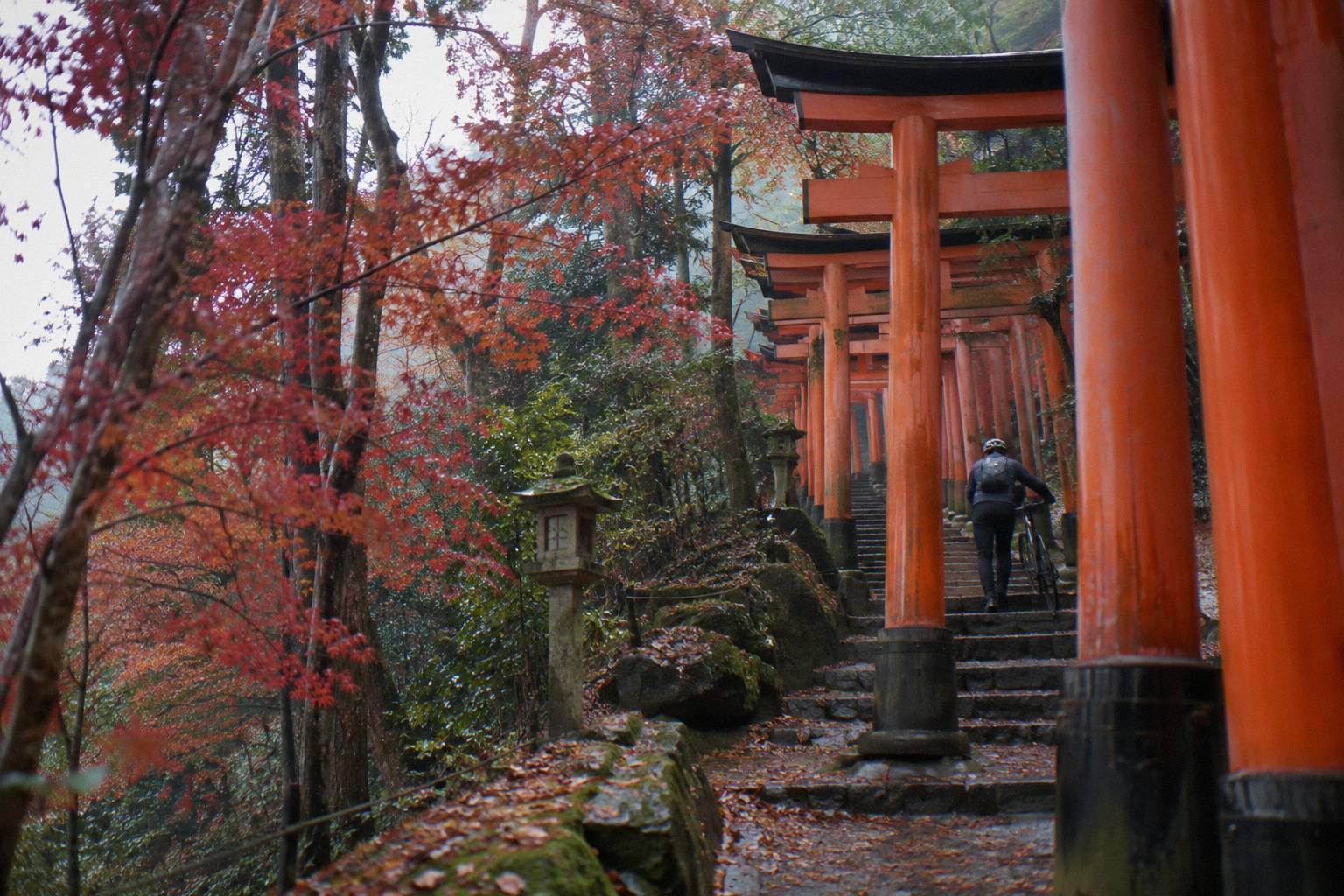
The Fushimi Inari and sento ride pairs the shrine's roughly 10,000 torii, which charge no admission, with a stop at a sento bathhouse, with a towel for the bath named in the inclusions alongside a reusable water bottle and a fox-shaped ema. In November and December a warm bath stop mid-ride is the most seasonal inclusion on the roster. It has no star claim yet, with 10 reviews, so judge it on the itinerary rather than a rating, and ask the operator anything the inclusions leave open.
The Silver Pavilion ride, run by Kyoto Fun, covers the north-east where ginkgo and maple sit a short ride apart, with e-bike rental, a guide and landing and facility fees included, minimum age 12. The Zen temples loop runs 4 hours 30 minutes with a Kyoto lunch at a Japanese house, vegan and vegetarian available but fish stock used, Kennin-ji entrance and helmet included, minimum age 15. Between them the three rides cover south, east and central stops without repeating each other, so a two ride trip in one foliage week sees different ground twice.
E-Bike Or Regular Bike For A November Ride?
For a November or December ride the fit question is duration and temperature, not terrain: the dated autumn-suitable roster rides are e-bike products, the 4 to 5 hour formats keep you outside through the cool part of the day, and e-bike assist is standard across all three featured loops. A pedal bike remains a legal bicycle with the same rules; e-bikes that meet the standard are bicycles too.
Kyoto City's cycling rules page classifies a pedal-assist e-bike within the legal standard as a bicycle, so the same road rules, fines and helmet effort duty apply either way; read the detail on the Kyoto City page on cycling rules. The rider-fit comparison, including who the assist actually serves, sits in the e-bike or regular bike guide, and the broader trade-offs are in whether guided beats self-guided riding.
For riders who want the full day in foliage season, "Bike Kyoto's Grand Loop: Full-Day Kyoto E-Bike Tour - 5 Top Sites" runs 7 to 8 hours from ¥26,000 per person with e-bike, helmet, admission fees, snacks and a light lunch included, minimum age 16, rated 5.0 from 596 reviews. A full day in November means starting near a mean daily minimum of 8 °C and finishing well before dark, so the light lunch and admission-included structure does real work. A multi-speed pedal bike is available on request at no additional charge on that ride, for anyone who would rather earn the kilometres.
What Rules And Costs Catch Autumn Riders Out?
Since 1 April 2026 riders aged 16 and over pay fixed fines of 3,000 to 12,000 yen for minor violations: 12,000 yen for holding a phone while riding, 6,000 for ignoring a signal, 5,000 for riding with an umbrella, 3,000 for riding two abreast. Helmets have been an effort duty for every age since 1 April 2023, with no fine. A removed bicycle costs 3,500 yen to reclaim and is held four weeks.
The blue ticket system replaced criminal procedure for minor violations, per the Kyoto City cycling rules page linked above. The umbrella fine matters most in foliage season's one wet scenario: November is dry by comparison with October, but 73.9 mm still falls somewhere in the month, and holding an umbrella while riding costs 5,000 yen, more than three Tofuku-ji garden entries. A rain jacket is the legal answer; the morning ride from Kyoto Station lists a raincoat among its inclusions. The same fines cover phone use at 12,000 yen, and since 1 November 2024 holding a phone to talk or watch the screen can mean up to 6 months in prison or a 100,000 yen fine, so a handlebar photo stop means stopping, not glancing.
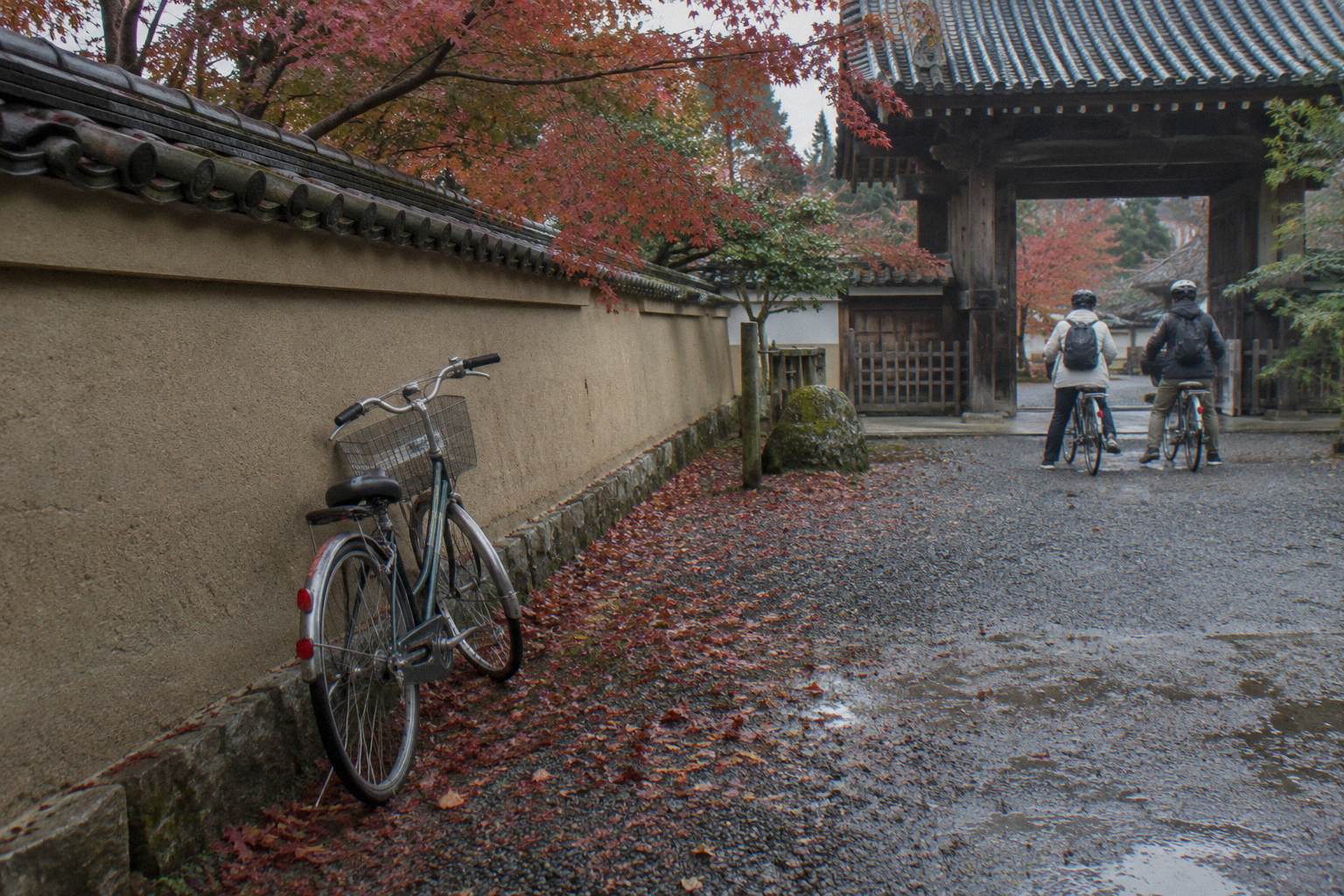
Helmet duty is stated on the Kyoto Prefecture page on the helmet effort duty: every cyclist of every age must make an effort to wear one, with no fine attached. Most roster rides name a helmet as included, so the effort duty costs you nothing on a guided ride. Kyoto Prefecture also requires bicycle liability insurance, and two roster lines name it explicitly: the morning ride from Kyoto Station includes liability insurance, and the Zen temples loop includes bike insurance covering bodily injury liability. The rest of the rulebook is in the cycling rules reference guide.
Parking is the quieter cost. Illegally parked bicycles are removed across nearly the whole city and stored; reclaiming one costs 3,500 yen per bicycle and the depot holds it four weeks from the day after removal, per Kyoto City's removed-bicycle page. On a guided ride the operator manages parking; two roster lines name bike parking fees as included among the full day options. For independent riders, the guide to leaving bikes legally covers the rest.
The fixed fines scale in a way that tells you what the authorities care about most. Phone use at 12,000 yen sits at the top of the range, double the 6,000 yen signal fine and four times the 3,000 yen two-abreast fine, and the criminal penalties introduced in November 2024 sit far above the blue ticket system entirely. For context on how much these amounts hurt: the cheapest fine on the list matches a single Tofuku-ji garden entry, while the most expensive one equals roughly seven entries.
Worth remembering is who the fixed fines apply to: riders aged 16 and over. Younger riders are not in the blue ticket system, but the helmet effort duty covers every age, and the insurance requirement applies regardless of age. Anyone planning a family ride in foliage season should check the cycling rules reference guide for how younger riders are handled.
Do You Need To Book Autumn Rides In Advance?
Yes, for the cluster of dates around the observatory normals: late November to mid December is when visitors target the colour, and every ride discussed here runs on dated departures with free cancellation up to 24 hours before start. Booking the date early and holding the cancellation window is the structure that fits a season the observatory itself frames as a normal plus a record range.
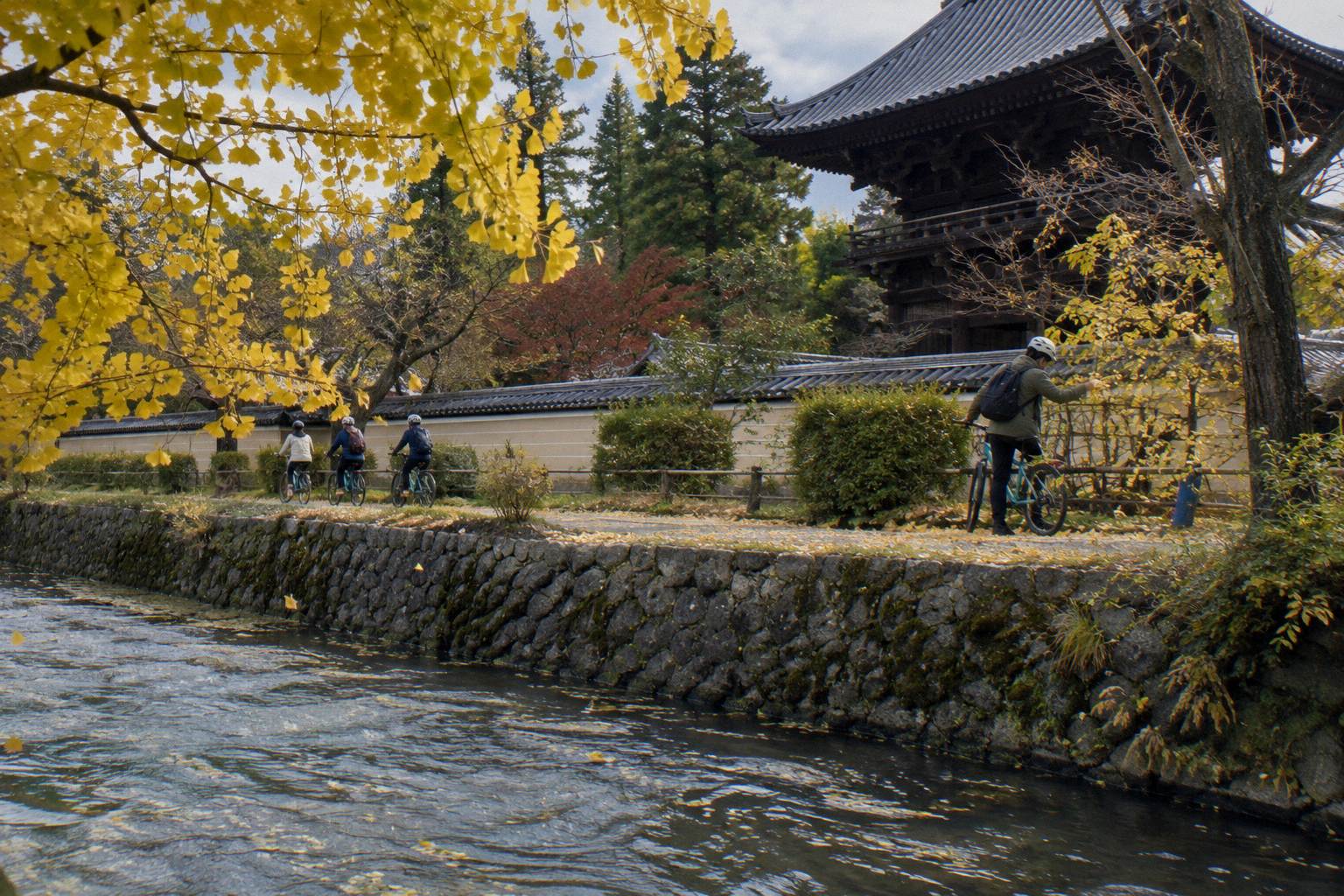
The booking logic writes itself from the data. The maple marker's record range spans six weeks, 10 November 1976 to 20 December 2024, so nobody can promise which week colours. What you can control is having a seat on a dated ride and keeping the free cancellation up to 24 hours before start as your escape hatch. The advance-booking question in general is covered in whether you need to book a Kyoto ride ahead.
Rain is the other swing factor, and the answer is short: with 73.9 mm across November, a wet day is possible but not the pattern, and the roster's cancellation terms apply either way; ask the operator about anything beyond them. Group size and format are the last variables; the sento ride and the Silver Pavilion ride are shared departures, while riders who want the foliage season kept private can look at the private versus small group comparison before committing.
How Does The Evening Foliage Window Change The Ride Choice?
The observatory normals put colour into the shortest-daylight stretch of Kyoto's year, so ride duration becomes the decision: a 4 hour loop from a mid-morning slot finishes in daylight, while a 3 hour 45 minute night ride moves the whole experience after dark. Both exist on the roster, and the choice is ride length against daylight, not route quality.
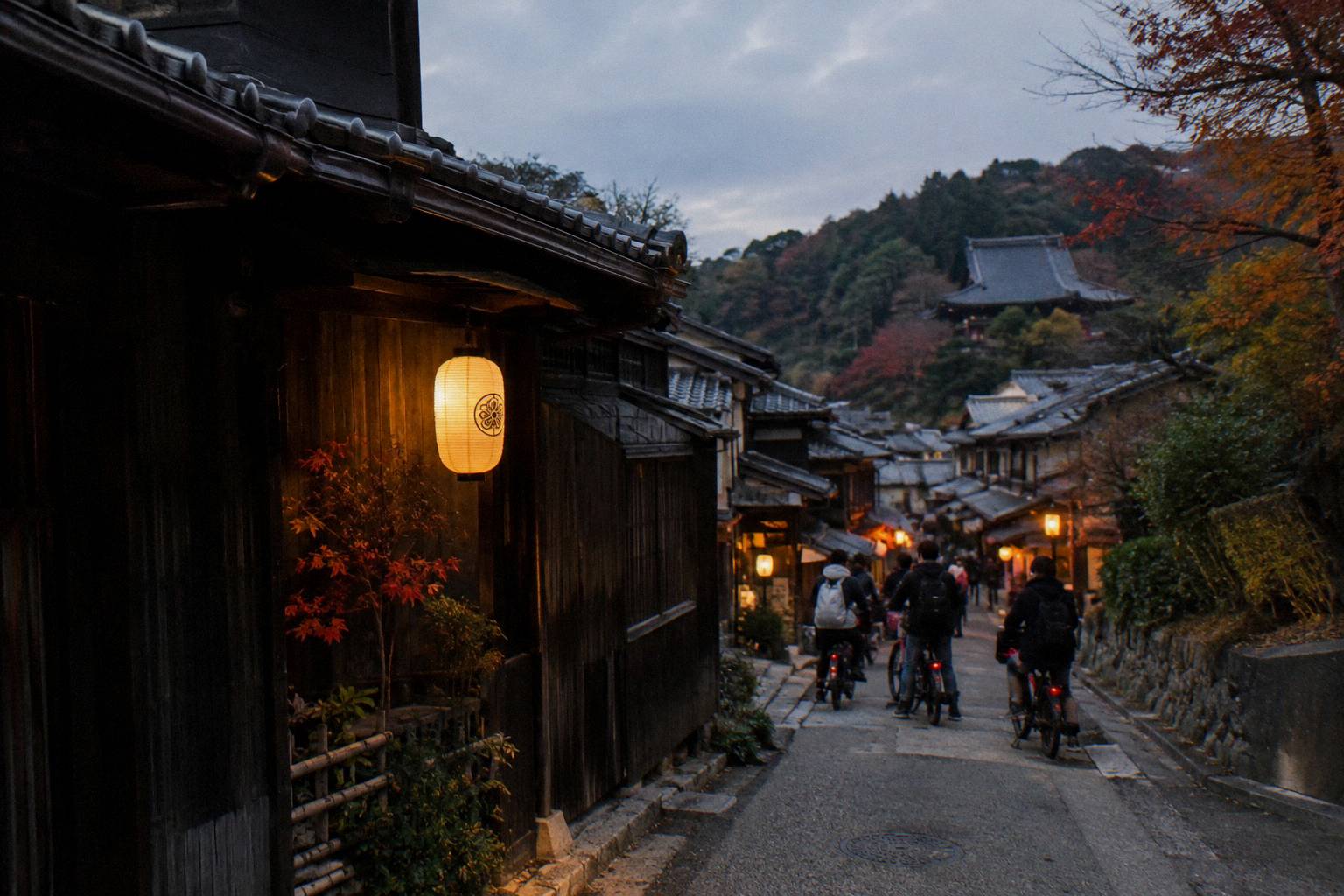
"Discover Kyoto at Night by Bike" runs 3 hours 45 minutes with a guide named as Jaime, bottled water and all entrance fees included, minimum age 10, rated 4.9 from 53 reviews; its price is on the booking page. Illuminated temple grounds are an autumn institution in Kyoto, and a night product is the only way a ride covers them, since start and meeting times are set on the booking page. The evening-rides landscape generally is mapped in the night cycling guide.
Against that, the standard four hour day loops, the sento ride, the Silver Pavilion ride and the Zen temples loop, all place their temple stops inside opening hours by design: Tenryu-ji closes at 17:00, Kinkaku-ji at 17:00, Ginkaku-ji at 17:00 through 30 November and 16:30 from December. A ride that names a temple stop is a ride built around those hours, which is why the day products cluster at four to four and a half hours. For the route-by-route picture across the year, the overview of Kyoto cycling routes puts all of them side by side.
What Trips People Up Before You Book
The recurring autumn mistakes are all timing and money errors: chasing a "peak week" that no official source defines, forgetting that Tofuku-ji's bridge fee doubles to 1,000 yen inside the foliage period, assuming admission is included on rides whose inclusions do not name it, and holding an umbrella on a wet November day, a 5,000 yen violation. Each one is avoidable with a two minute check before booking.
The first mistake is treating 5 December as a guarantee. It is a 1991-2020 normal on a reference tree; 2025 came in on 10 December and the record runs six weeks wide. Book dates you can travel, keep the free cancellation window, and let the marker inform expectations rather than dictate them.
The second is fee arithmetic. The Tofuku-ji combined ticket at 1,000 yen equals the two separate fees outside the foliage period and beats them inside it, and Ginkaku-ji doubled to 1,000 yen on 1 April 2026. Riders who budgeted from an older guide arrive short. Third, check inclusions line by line: the Silver Pavilion ride includes landing and facility fees, the Zen temples loop includes Kennin-ji, while the full day no-meal product names lunch as excluded outright.
The fourth is weather gear. November's 73.9 mm arrives on some days, and the umbrella fine is 5,000 yen. A rain jacket solves it; one roster ride even includes a raincoat. Check availability on your date, ask the operator anything the inclusions leave open, and hold the 24 hour cancellation line as your flexibility.
Common Questions About Autumn Cycling In Kyoto
When Do Kyoto's Autumn Leaves Peak?
The observatory's official marker for maple colouring is normally 5 December, with ginkgo yellowing on 24 November. In 2025 the maple marker was 10 December. There is no official "peak week": the record range runs from 10 November 1976 to 20 December 2024.
Is November Too Cold For A Bike Ride In Kyoto?
No. November's mean daily high is 17.3 °C against a mean daily minimum of 8.4 °C, so layers handle the morning-to-afternoon swing. December is colder, with a high of 11.6 °C.
What Does Tofuku-Ji Cost In Autumn?
From 1 November 2026 the Hojo garden is 600 yen, Tsutenkyo bridge and Kaisando are 600 yen rising to 1,000 yen in the autumn foliage period, and a combined ticket is 1,000 yen.
Which Guided Ride Suits An Autumn Day?
Three dated loops fit: the Fushimi Inari and sento e-bike ride from ¥13,500 per person for 4 hours, the Silver Pavilion and Philosopher's Path ride from ¥14,500 per person for 4 hours, and the UNESCO Zen temples loop with lunch from ¥15,000 per person for 4 hours 30 minutes. All carry free cancellation up to 24 hours before start.
Do I Have To Wear A Helmet On An Autumn Ride?
Helmets have been an effort duty for cyclists of every age since 1 April 2023, with no fine attached. Most roster rides name a helmet as included, so on a guided ride one comes with the booking.
What Happens If It Rains On My Ride Date?
November is relatively dry at 73.9 mm, but rain happens. Rides carry free cancellation up to 24 hours before start, and any policy beyond that sits with the operator, so ask them directly. Riding with an umbrella is a 5,000 yen violation, so a rain jacket is the answer.