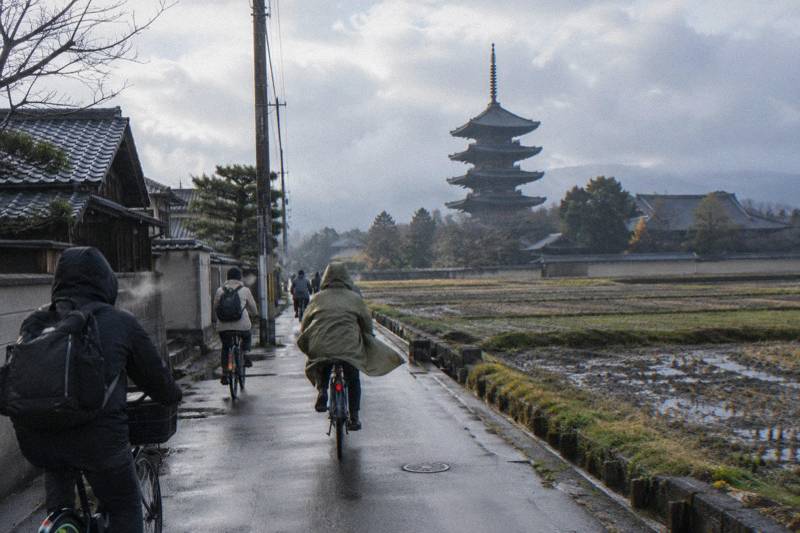
What Happens To A Guided Ride In Kyoto When It Rains?
How rain affects a guided cycling ride in Kyoto: cancellation windows, what the season data says, and which rides hand out a raincoat.
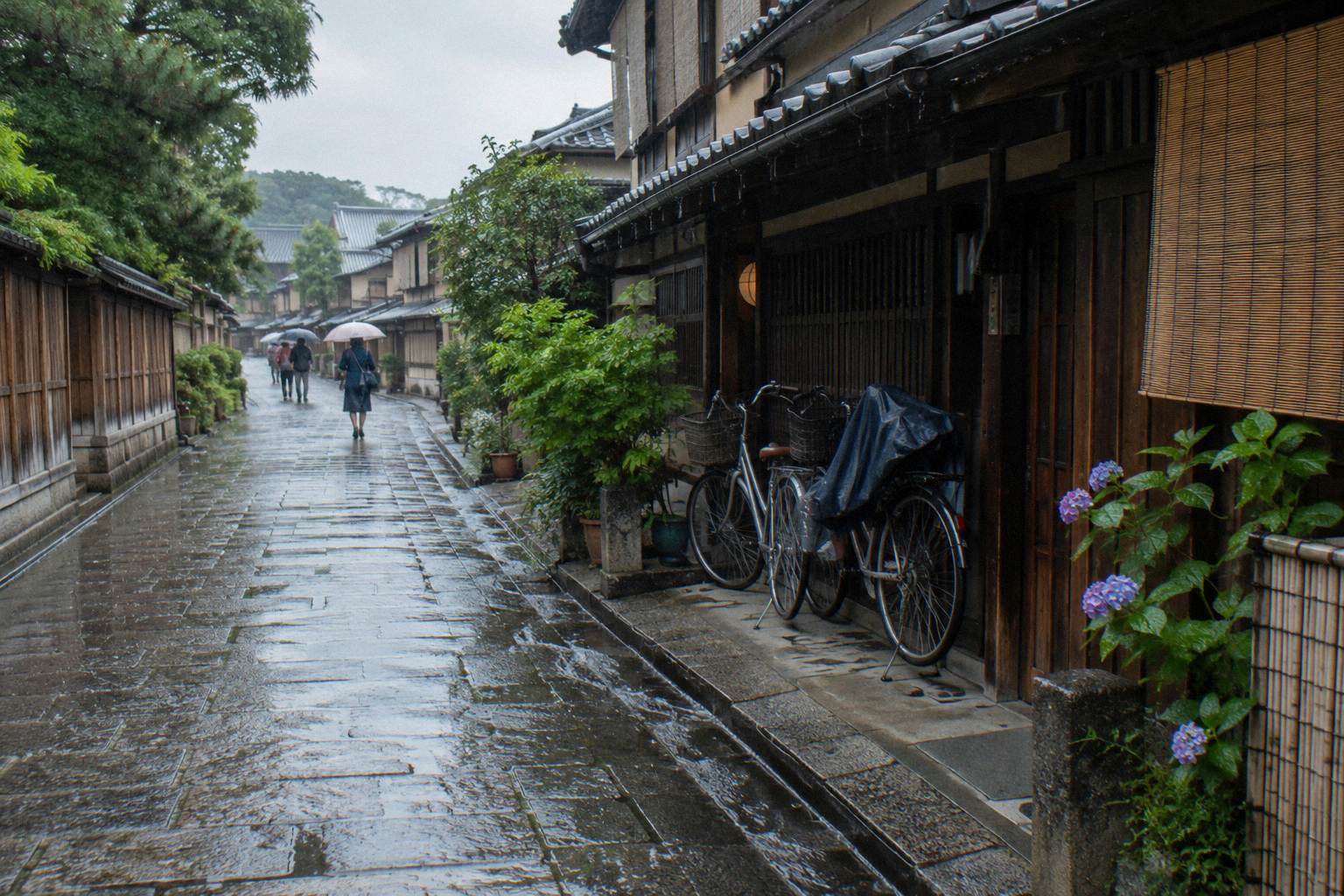
Rain is the one variable no ride operator controls, so the useful question is not whether it will rain but what your options are when it does. Kyoto's guided cycling scene runs year-round in a city where July alone delivers 223.6 mm of rain on the 1991 to 2020 normals, and rides still depart through the wet months. This article covers the rain-specific decision: cancellation windows, what rides hand out, which months carry the most water, and how to plan around a doubtful forecast without losing money.
| Fact | Detail |
|---|---|
| Free cancellation | Every ride discussed here allows free cancellation up to 24 hours before start |
| Rainiest month | July, 223.6 mm on the 1991 to 2020 normals |
| Second rainiest | June, 199.7 mm |
| Rainy season | Roughly early June to mid July |
| Ride that includes a raincoat | Morning Ride From Station, from ¥14,000 per person |
| Helmet duty | An effort duty for every age since 1 April 2023, no fine attached |
| Umbrella while riding | 5,000 yen fixed fine for riders aged 16 and over since 1 April 2026 |
| Operator rain policy | Ask the operator, since none is published in advance |
Most guided rides in Kyoto still run in light rain, and your protection is the cancellation window rather than a weather promise. Every ride covered here, including the Morning Ride From Station from ¥14,000 per person, allows free cancellation up to 24 hours before start. One rostered ride packs a raincoat into its inclusions. For heavy rain, the decision belongs to the operator, so ask the operator directly if the forecast looks serious.
The mechanics are simple once you separate the three things that can happen. First, the ride departs and you ride through showers; this is the common outcome for drizzle, and the 3 hours 30 minutes Morning Ride From Station explicitly lists a raincoat among what is provided, alongside water and a helmet. Second, you cancel yourself inside the free window and rebook a clearer day; every ride in this article carries free cancellation up to 24 hours before start. Third, the operator calls the ride off, a decision that belongs to them and depends on conditions on the day.
What no article can tell you is a threshold, because no operator on this roster publishes a millimetre figure or wind speed at which a ride is cancelled. Treat any weather app as a planning hint and the operator's word as the decision. If a typhoon-strength system is forecast, contact them early rather than waiting at the meeting point, and keep the cancellation deadline in mind so a refund is still on the table if the operator has not yet committed either way.
It also helps to know that light rain is normal riding weather in this city. Kyoto's climate delivers over 100 mm a month in every month from March through October, so local operators plan routes and run schedules with damp mornings built into the expectation. A wet forecast alone is not a signal that your ride is in doubt; a severe weather warning is a different matter entirely, and that is the point at which the conversation shifts to the operator.
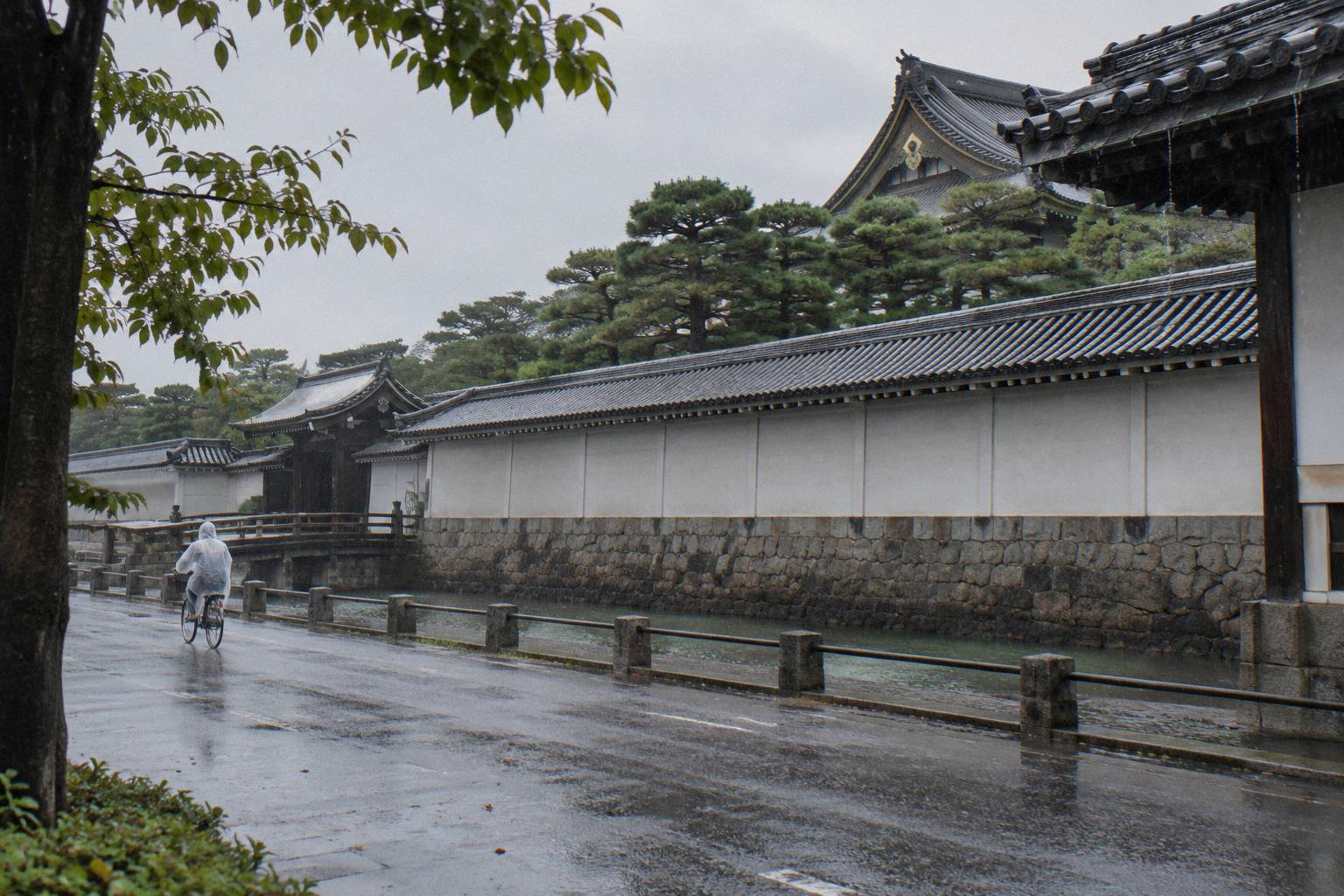
Can You Cancel A Kyoto Ride If Rain Is Forecast?
Yes, provided you act inside the cancellation window. Every ride discussed here offers free cancellation up to 24 hours before start, which means a next-morning ride can be cancelled the previous morning at no charge. The cutoff protects your money but not your plans, so watch the forecast on the evening before and decide then rather than at the meeting point.
The 24 hour window is the single most useful rain fact on this entire roster, because it is the same on every product covered here. The UNESCO Zen Temples, Lunch ride from MagicalTrip Inc., from ¥15,000 per person, carries it. So does the Full-Day E-Bike, Lunch Included loop, from ¥26,000 per person. The window runs from the scheduled start, not from midnight, so a ride beginning in the morning has its deadline the morning before, and a rider who cancels at 9 pm the night before a 9 am start has already missed it.
The trade-off is timing. Japanese forecasts are reliable about a day out and vague about three days out, so a ride booked for day four of your trip can sit under a cloud icon for days before the picture sharpens. Book the ride you want, then treat the 24 hour mark as your genuine decision point rather than cancelling on a five-day forecast that may clear. Cloud icons on a seven-day view in June and July are close to meaningless, because those months deliver rain on many days without washing out any of them.
One more nuance: the free cancellation covers your decision, not the operator's. If the operator cancels, you are not spending a cancellation at all; the booking simply does not run. The distinction matters most for riders holding a multi-booking day, where cancelling one ride yourself at the deadline is safe, but cancelling two rides on a pessimistic forecast can leave an empty afternoon that turns out dry and rideable.
If you are deciding whether a guided ride is even the right format for a wet-weather city, the comparison in guided versus self-guided riding walks through who handles what when plans change. A guide who can shorten a loop or shift a lunch break is worth more in a wet week than in a dry one.
Does Any Ride Include Wet Weather Gear?
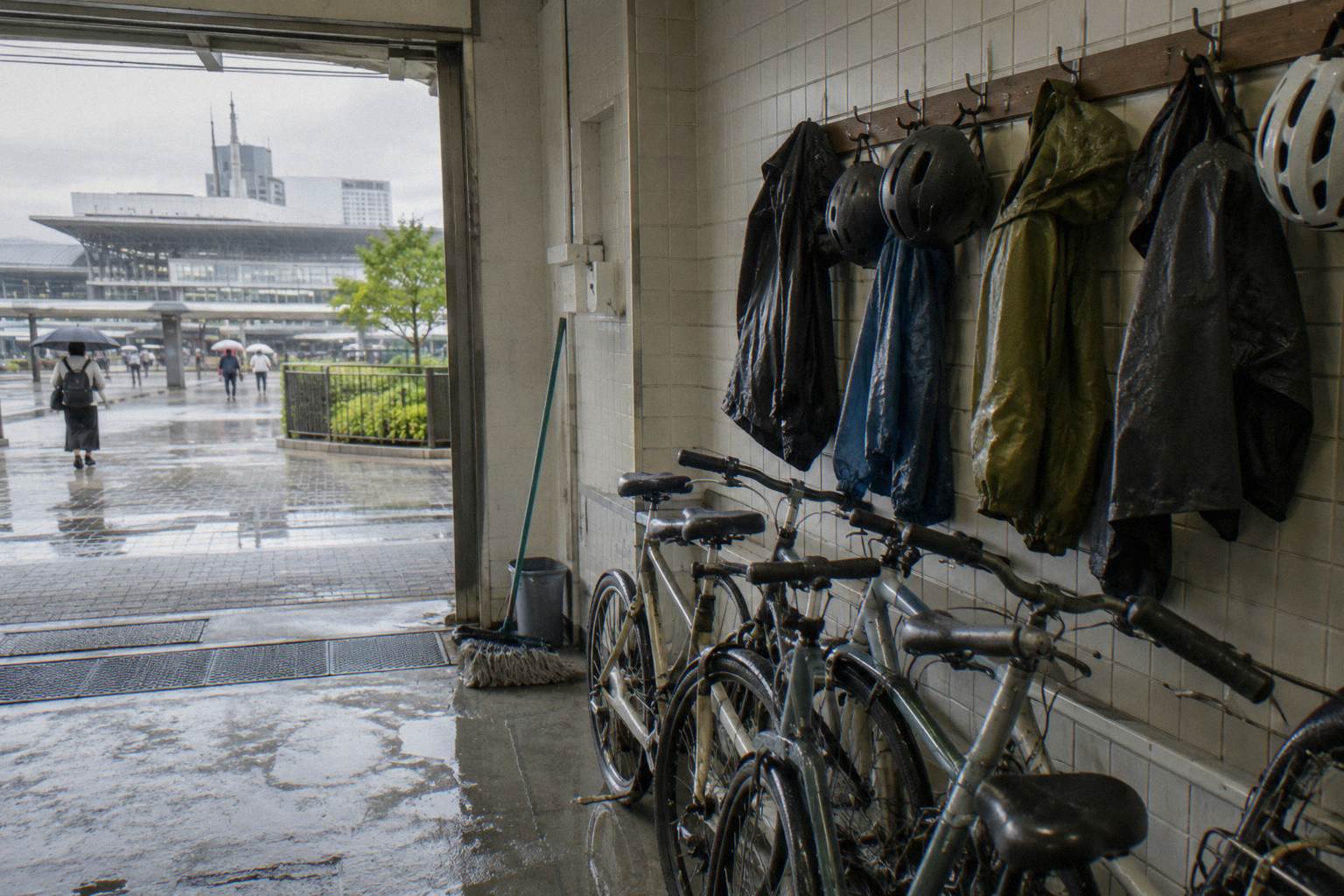
One ride on this roster names a raincoat as an inclusion: the Morning Ride From Station, from ¥14,000 per person, 3 hours 30 minutes, rated 5.0 from 20 reviews, minimum age 13, operated by 京都 ecoトリップ 本店. No other ride covered here lists rain gear among what is provided, so for anything else, bring your own lightweight waterproof or check with the operator before departure.
The rest of the roster's inclusions tell you what riders usually get instead: bottled water, helmets, e-bikes, and on some rides lunch or entrance fees. The UNESCO Zen Temples, Lunch ride includes a local Kyoto lunch at a Japanese house, helmets on request, and a bike lock, but names no rain gear. The Full-Day E-Bike, Lunch Included loop includes admission fees, a light lunch, snacks and electric-assist bikes, and again no raincoat. That asymmetry matters if your travel dates fall in June or July, when gear matters most.
A packed rain jacket weighs almost nothing, so the practical reading is: bring your own regardless, and treat the raincoat on the Morning Ride From Station as a bonus rather than a reason to pack light. The tour page for the Morning Ride From Station shows the full inclusion list, which also covers liability insurance and a raincoat alongside the expected water and helmet.
There is a legal angle that makes a hands-free waterproof more than a comfort choice. Riding with an umbrella carries a 5,000 yen fixed fine for riders aged 16 and over since 1 April 2026, so a rider without a jacket has no lawful way to stay dry mid-ride. That single rule is the strongest argument for packing your own gear even when the forecast looks marginal.
When Does It Rain Most In Kyoto?
July is Kyoto's wettest month with 223.6 mm on the 1991 to 2020 normals, followed by June at 199.7 mm, and the rainy season runs roughly early June to mid July. August turns hot rather than wet, with a mean daily high of 33.7 °C. The driest months are January at 53.3 mm and December at 57.3 mm, which makes winter the lowest-risk window for a ride and early summer the highest.
The monthly picture comes straight from the Japan Meteorological Agency Kyoto monthly normals, and it is more nuanced than a single wet season. March and April sit at 106.2 mm and 117.0 mm, moderate by Kyoto standards. May rises to 151.4 mm, June to 199.7 mm, and July peaks at 223.6 mm. September stays damp at 178.5 mm, then October drops to 143.2 mm and November to a comfortable 73.9 mm.
| Month | Rain (mm) | Mean daily high (C) |
|---|---|---|
| January | 53.3 | 9.1 |
| April | 117.0 | 20.1 |
| June | 199.7 | 28.1 |
| July | 223.6 | 32.0 |
| August | 153.8 | 33.7 |
| October | 143.2 | 23.4 |
| November | 73.9 | 17.3 |
Two practical readings follow. A ride in the cherry blossom window around the 4 April full bloom normal faces moderate rain odds, while a ride in late June or July faces the year's highest. And because rain in Kyoto often arrives in bursts rather than all-day drizzle, a wet month is not a washout month; it simply raises the chance that any given morning includes a shower. A rainy-season ride is entirely feasible, it simply rewards a rider who has packed for it and knows the cancellation deadline.
September deserves its own mention: at 178.5 mm it is the third wettest month, yet it sits outside the classic early June to mid July rainy season, so visitors who assume the rain ends in August get caught out. October at 143.2 mm is still damp by the standards of most cycling cities, and it is November at 73.9 mm that finally pairs low rain with a mild 17.3 °C mean daily high. More seasonal planning detail lives in the rainy season cycling guide, which this article deliberately does not duplicate.
Do Rides Get Shortened Or Rerouted In Rain?
No operator here publishes a rain-shortened route or an alternative itinerary, so no shortened-route claim can be made for any specific ride. What is verifiable is the duration of each product in normal conditions and the cancellation window that applies regardless. If conditions on the day force a change, the guide decides on the ground, and the operator's word at the meeting point is the only reliable version of the plan.
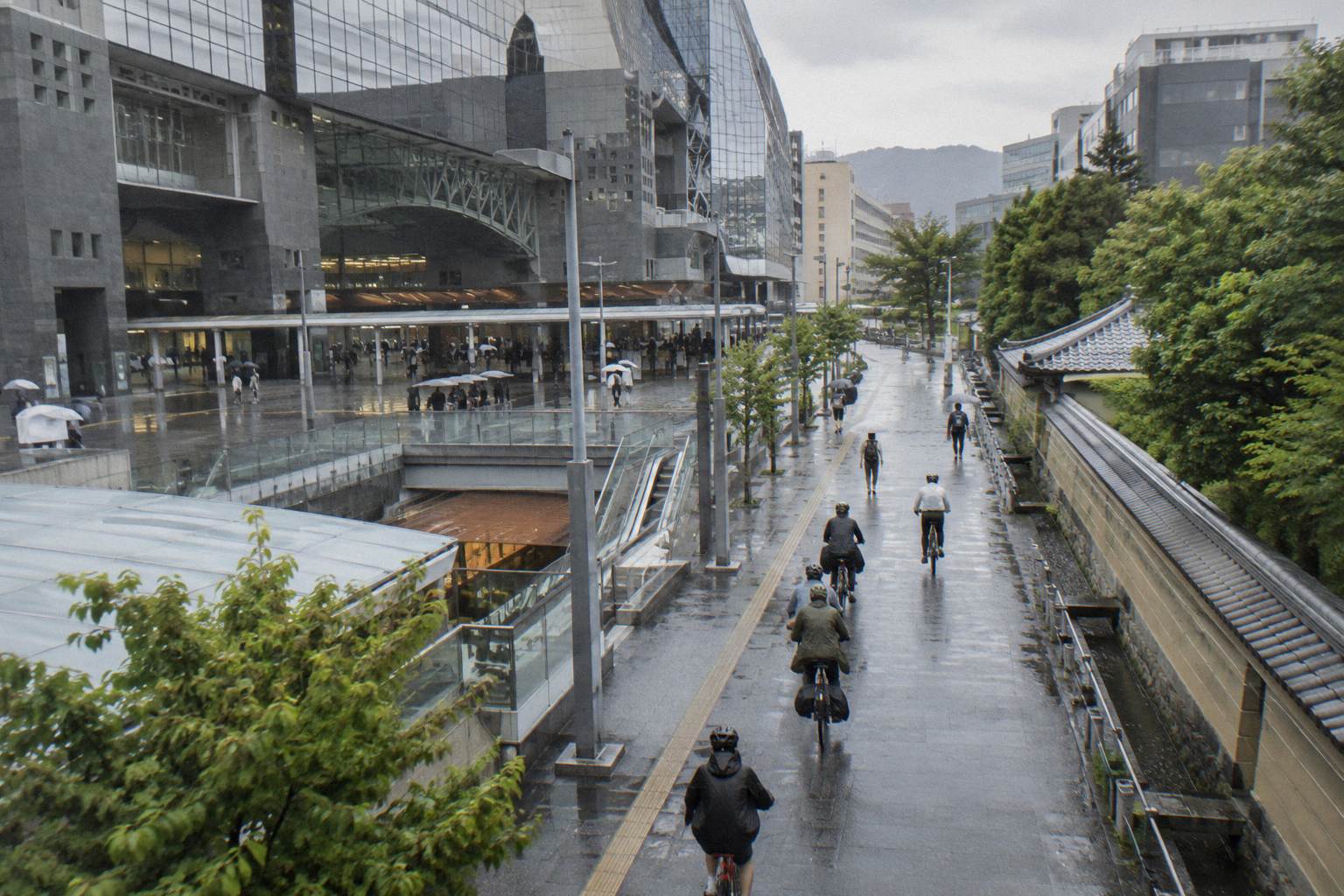
The durations on this roster give you a sense of exposure. A 3 to 4 hour ride such as the Early Bird Bamboo Forest Ride from Kyoto Bike Tour, rated 5.0 from 773 reviews, spends fewer hours outside than the 7 to 8 hours of the Full-Day E-Bike, Lunch Included loop from the same operator, rated 5.0 from 596 reviews. A longer ride is not more likely to be cancelled, but it covers more hours in which weather can move through, and its lunch break gives a natural dry pause that shorter rides lack.
Guides on these rides are a real asset in changeable weather, since a local operator reads the sky over their own city far better than a visitor does. The related question of whether an English-speaking guide is included on Kyoto rides covers who leads what, which matters most precisely when plans shift mid-ride. A guide who can explain a route change clearly in English turns a wet detour into a footnote rather than a lost morning.
Riders sometimes assume a shorter ride is the safer wet-weather bet, but the roster complicates that. The 3 hours 45 minutes Night Ride By Lantern Light from Jaime, rated 4.9 from 53 reviews, runs after dark when rain is harder to see and lights matter more, while the 5 to 6 hours Backstreets, 5 To 6 Hours e-bike tour from Memory Kyoto Bike Tour, rated 4.9 from 210 reviews, includes all fees and taxes plus helmets, giving it more moving parts to protect. The framing: duration sets exposure, inclusions set comfort, and neither is published as a rain policy.
Which Ride Should You Pick For A Wet Forecast?
For a forecast with showers, the Morning Ride From Station is the natural pick because it is the only rostered ride that includes a raincoat, and its 3 hours 30 minutes format limits exposure. For a doubtful day, pick any ride and rely on the shared 24 hour free cancellation, or shift toward a lunch-inclusive ride such as UNESCO Zen Temples, Lunch, which builds a long indoor break into the middle of the route.
The lunch-bearing rides deserve a second look in wet months. The UNESCO Zen Temples, Lunch ride, from ¥15,000 per person, 4 hours 30 minutes, rated 5.0 from 145 reviews, minimum age 15, includes a local Kyoto lunch at a Japanese house, with vegan and vegetarian options available though fish stock is used. The Full-Day E-Bike, Lunch Included loop includes a light lunch plus snacks across its 7 to 8 hours. A sit-down meal mid-ride is a structural dry window, whatever the weather does around it.
| Ride | From price | Duration | Rating | Rain-relevant inclusion |
|---|---|---|---|---|
| Morning Ride From Station | ¥14,000 per person | 3 hours 30 minutes | 5.0 from 20 reviews | Raincoat, water, helmet, liability insurance |
| UNESCO Zen Temples, Lunch | ¥15,000 per person | 4 hours 30 minutes | 5.0 from 145 reviews | Local Kyoto lunch at a Japanese house, helmet on request |
| Full-Day E-Bike, Lunch Included | ¥26,000 per person | 7 hours to 8 hours | 5.0 from 596 reviews | Light lunch, snacks, admission fees, e-bike |
Price is the other axis. Minimum ages also differ, from 13 on the Morning Ride From Station to 15 on the lunch ride and 16 on the full-day loop, which matters for families weighing a wet-day booking. For a full pricing breakdown across formats, the guided ride prices compared guide sets out the whole spread, and it is worth a look before committing to a date in the wet season.
What Should You Bring For A Possibly Wet Ride?
Bring your own waterproof regardless of inclusions, plus shoes you would not mind getting damp, since no ride on this roster lists shoe covers, gloves or dry bags among its inclusions. Helmets are provided on the rides named here, which matters more than usual on wet roads. Beyond that, pack light: everything you carry rides with you for the full 3 to 8 hours of the route.
Two legal points shape a wet ride in Kyoto and are worth knowing before you pedal off. Riding with an umbrella is a violation, fined 5,000 yen under the Kyoto City page on cycling rules, since 1 April 2026, so a hands-free waterproof is not just sensible but effectively required. And helmets have been an effort duty for every age since 1 April 2023, per the Kyoto Prefecture page on the helmet duty, with no fine attached but a clear expectation.
The full rule set, including the blue ticket system for riders aged 16 and over, is collected in the cycling rules guide for visitors. One rain-adjacent extra: if you leave a bicycle where it should not stand and it gets removed, reclaiming it costs 3,500 yen per bicycle, and the bikes are held for four weeks from the day after removal, a detail that matters most in a downpour when riders park hastily under the nearest awning. On a guided ride this is the operator's problem rather than yours, since the guide handles where the group stops and parks, which is one quiet argument for guided over self-guided on a wet day.
What Trips People Up Before You Book
The commonest rain mistakes are cancelling too early on a long-range forecast, assuming every ride includes a raincoat when only one does, and treating the operator's go-or-no-go decision as automatic. Each is avoidable: wait for the 24 hour window, pack your own waterproof, and message the operator when a serious system is forecast rather than deciding unilaterally.
The first mistake is cancelling on a five-day forecast. Kyoto forecasts sharpen dramatically inside 48 hours, and free cancellation up to 24 hours before start means you lose nothing by waiting. Riders who cancel on a cloudy icon a week out often watch the day arrive clear.
The second is assuming gear. Only the Morning Ride From Station names a raincoat. The big-review rides, including the Backstreets, 5 To 6 Hours e-bike tour from Memory Kyoto Bike Tour, rated 4.9 from 210 reviews, list water, e-bikes, fees and helmets, and nothing for rain.
The third is reading a drizzle forecast as a cancellation. Operators run rides in light rain as a matter of course, and a ride that goes ahead is owed its full price even if you stay in the hotel. The fourth is forgetting the 24 hour window is measured from the start time, not from midnight, which catches early-morning bookers every week.
A fifth trip-up is underestimating June and July. Visitors who book around the 4 April cherry blossom full bloom normal face moderate rain odds of 117.0 mm for the month, while late-June visitors face the wettest stretch of the year and should treat the forecast check the evening before as a fixed part of the routine. Kyoto Bike Tours keeps the season-by-season detail in its planning guides so the rain decision never has to be a guess.
Common Questions About Riding Kyoto In Rain
What Happens To A Guided Ride In Kyoto When It Rains?
Light rain usually means the ride runs; every ride here allows free cancellation up to 24 hours before start, and the Morning Ride From Station includes a raincoat. For heavy rain the operator decides, so ask the operator when the forecast is serious.
Is June Or July Worse For Rain In Kyoto?
July is wetter, with 223.6 mm on the 1991 to 2020 normals against June's 199.7 mm. Both sit inside the rainy season that runs roughly early June to mid July.
Do Kyoto Rides Get Cancelled For Typhoons?
No operator on this roster publishes a typhoon policy, and no peak typhoon months are confirmed on official pages read for this site. Treat a typhoon forecast as a reason to contact the operator and use the 24 hour free cancellation if needed.
Is Riding With An Umbrella Allowed In Kyoto?
No. Riding with an umbrella carries a 5,000 yen fixed fine for riders aged 16 and over since 1 April 2026, which is one reason the raincoat inclusion on the Morning Ride From Station matters.
Do I Lose My Money If I Cancel For Rain?
Not inside the window. Free cancellation up to 24 hours before start applies to every ride discussed here, from the ¥14,000 Morning Ride From Station to the ¥26,000 Full-Day E-Bike, Lunch Included loop. After the window closes, the booking is live unless the operator cancels.
Which Ride Includes A Raincoat?
One: the Morning Ride From Station, operated by 京都 ecoトリップ 本店, 3 hours 30 minutes, from ¥14,000 per person, rated 5.0 from 20 reviews. It also lists water and a helmet among its inclusions.